

A quick note: a few links below are affiliate links. Buy through one and we may earn a small commission. It never costs you more, and we only point to gear we'd actually put in front of our own dogs. As an Amazon Associate I earn from qualifying purchases.
Dachshunds turn heads on city sidewalks, and there’s a reason you see so many of them in apartments. They’re smart, playful, and loyal. They’re also famously stubborn, which is the part nobody mentions until you own one.
But, are Dachshunds good apartment dogs?
Dachshunds can be good dogs for apartment living. It’s a small breed that adapts well to living in small spaces. They are active and lively dogs that as long as they have daily exercise and are properly trained and socialized, they are great companions for apartment life.
He’s not the right pet for everyone, though. Raise him wrong from the start and you can end up with a dog that chews, snaps, or hides from the world.
What a Dachshund really needs is an owner who gets him. Someone who understands the quirks and is willing to work around them, especially in a small apartment where there’s nowhere for bad habits to hide.
What You Should Know About Living with a Dachshund

You’ll hear them called sausage dogs, wiener dogs, even badger dogs. The nicknames all point at the same shape: short legs, long back, and a personality that doesn’t match the size.
There are three coat types, shorthaired, longhaired, and wirehaired, and three sizes. You’ll mostly run into the standard and the miniature. The so-called rabbit Dachshund exists but you rarely meet one in the States.
The temperament is the fun part. Bright, lively, always up for something. Just remember what they were bred for. This is a hunting dog at heart, which is where the stubborn streak and the urge to chase squirrels comes from.
That hunting past is ancient history to most of them now. Today’s Dachshund is a companion first, and a genuinely entertaining one. Few breeds make their owners laugh as often.
Is a Dachshund a Good Family Dog?
Train him well and a Dachshund makes a fine family dog. He’s affectionate, playful, and loyal, and he tends to do well with kids who treat him kindly.
Small children are where you have to pay attention. That long spine doesn’t take rough handling, and a Dachshund who gets hurt by a clumsy toddler may snap to defend himself. The fix is supervision, not avoidance.
Other dogs are a tougher sell. Plenty of Dachshunds would rather be the only dog in the house, or share it with another Dachshund and nobody else.
Are Dachshunds High Energy Dogs?
People look at those stubby legs and assume couch potato. They’re wrong. A Dachshund has more drive than his frame lets on.
Remember the job they were bred to do. Hunting dogs are built for stamina, and that energy didn’t disappear because he now lives on the fourth floor. He needs real exercise to stay healthy and out of trouble.
Figure on at least 60 minutes a day for a standard Dachshund and around 30 for a miniature. Those are floors, not ceilings. Give either one more and he’ll take it gladly.
Exercise does double duty. It keeps the weight off a back that can’t afford extra pounds, and it burns the mental energy that otherwise turns into barking and chewing.
Puppies are the exception. Don’t overdo it while the joints are still forming, or you risk long-term damage to that delicate frame.
The rule of thumb is five minutes per month of age, once a day. Early on, a bit of play around the apartment covers it. Once the shots are done, you can start adding real walks.
Are Dachshunds Low Maintenance?
Grooming depends entirely on the coat. Remember, there are three: shorthaired, wirehaired, and longhaired.
The shorthaired is the easy one. A brush once a week and a bath about once a month is plenty. If low effort is what you’re after, that’s your dog.
The other two ask for more, the longhaired most of all. Skip the daily brushing on a longhaired Dachshund and you’ll be fighting mats within a week.
Are Dachshunds Easy to Train?
The reputation is rough. Dachshunds get called hard to train, and there’s truth in it. They think for themselves, they dig in their heels, and they have a real mischievous side.
Here’s the flip side. They’re clever and they like learning, so once you find what motivates him, usually food, the lessons land faster than you’d expect.
Patience and consistency are the whole game. A few things that make it go smoother:
- Reward what you want with praise and treats, and simply ignore what you don’t. Skip punishment. It only scares and confuses him.
- Train somewhere boring. Dachshunds get distracted by everything, so they need to be able to focus on you and nothing else.
- Keep it short. Several five-minute sessions across the day beat one long slog every time.
Are Dachshunds Hard to Potty Train?
Brace yourself for this one. Dachshunds are sharp, but the same stubbornness that complicates obedience makes house training slow going.
Stay consistent and you’ll get there. It just takes longer than it does with most breeds.
When living in an apartment there are usually two options to potty train a dog. Going outside is the better one. The extra trips give him more to sniff, see, and move through, which is good for body and mind.
When getting outside fast isn’t realistic, pee pads or grass pads can be used in an apartment.
To teach him to go outside, work through these steps:
- Take him to the same spot on a regular schedule. The routine cuts down on indoor accidents and helps him link that place with going to the bathroom. At the start, out every hour, then stretch the gaps as he gets it.
- Praise and treat him the moment he goes where you want.
- Catch him starting indoors? Interrupt with a sound and get him outside fast so he finishes there. Reward him when he does.
- Find an accident after the fact and let it go. Scolding means nothing to him after the moment has passed, and all it does is make him afraid of you. Clean the spot well with the right cleaner so no smell pulls him back.
Pad training works much the same way. Instead of heading for the door, you steer him to the pad over and over until it clicks.
One detail matters: dogs avoid soiling where they eat, sleep, and play. Put the pads somewhere separate, away from his bed and bowls, or he won’t use them.
It’s slow, but patience and persistence pay off. Most owners need two to four weeks of steady work to get a Dachshund reliable.
Can Dachshunds Be Left Alone?
Four hours is about the limit, and even that’s pushing it. These are pack dogs. They want their people nearby.
Leave one too long, too often, and anxiety creeps in. Some go on to develop full separation anxiety, which is a much harder thing to undo.
You’ll know it when you hear it. Nonstop barking, howling, and chewed-up belongings are the classic signs of a Dachshund left alone too much.
Do Dachshund Dogs Bark a Lot?
Yes, and you should know that going in. Barking is wired into a breed that was built to hunt and signal.
Some are louder than others, but as a group they’ll bark at the mail carrier, the elevator, a leaf, you name it.
The usual reasons a Dachshund overdoes it:
- Guarding his turf and sounding the alarm on anything he reads as a threat.
- Frustration and boredom when he’s short on attention and exercise.
- Anxiety, which spikes when he’s left alone.
- Plain attention-seeking, whether he wants out to pee or just wants to play.
In an apartment that voice carries, and the neighbors notice. You’ll never shut a Dachshund up entirely, and you shouldn’t try, but you can absolutely train him to dial back the excess.
Are Dachshunds Expensive to Own?
Like any dog, a Dachshund comes with a price tag you should think hard about before signing up.
Upfront, between early vet visits, the basic gear, and a little training, expect somewhere in the $500 to $1,500 range.
Then there’s the ongoing stuff:
- Food. Around $50 per month.
- Toys. Between $25 and $50 per year.
- Medical Expenses. About $200 to $500 a year.
- Pet Insurance. Between $10 to $50 a month.
And budget for the curveballs. With a back-sensitive breed, the surprise vet bill isn’t a question of if so much as when.
Before you bring any dog home, be honest about whether you can cover what he needs for a healthy, happy life.
Is a Dachshund a Good Apartment Dog?
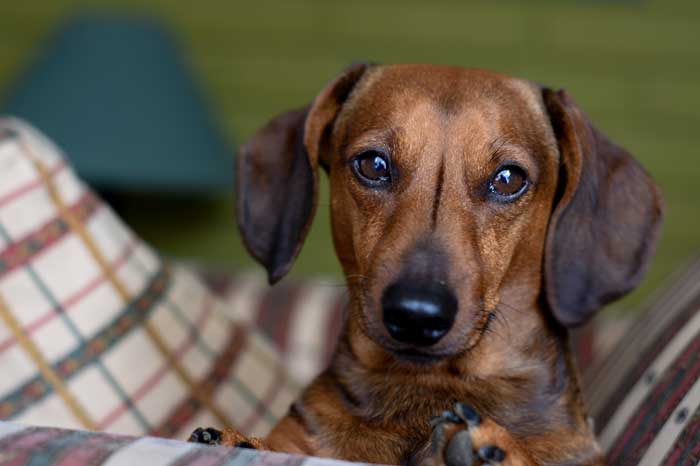
He can be a great one. The small size fits tight spaces, and while he’s energetic, his exercise needs sit below what a lot of bigger dogs demand.
Easy to live with, though? Not always. A Dachshund is a roommate with opinions, and a few of them are worth weighing before you share a flat with one:
- Dachshunds bark a lot.
- Dachshunds are high energy dogs.
- Dachshunds can bark excessively and be destructive when left alone.
- Dachshund can become suspicious and aggressive towards strangers and other dogs.
None of that is a dealbreaker. With the right habits in place, a Dachshund settles into apartment life as well as any small breed.
Tips for Raising a Dachshund in an Apartment
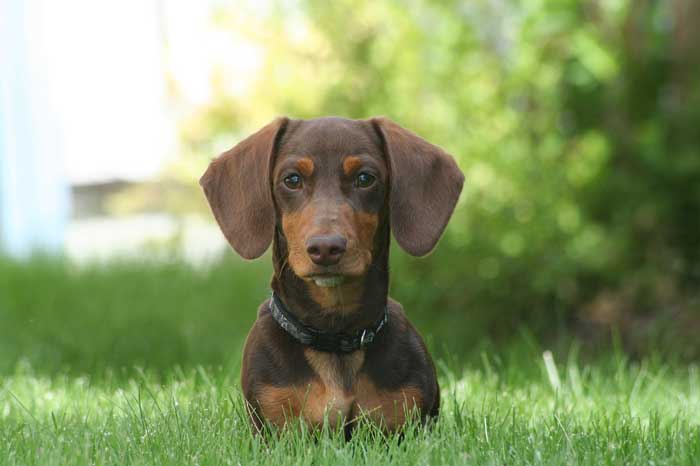
Teach Your Dachshund Not to Bark to Much
For a dog this size, the bark is shockingly big. Deep, loud, and aimed at pretty much everything that moves.
You can’t silence a dog completely, and you wouldn’t want to. What you can do is take the edge off the excess.
The trick that works best sounds backwards. You teach the “Speak” command first, then teach “Quiet” on top of it.
Start with “Speak”:
- Trigger a bark on purpose. A knock on the door usually does it.
- The second he barks, show the treat, say “Speak” in a calm, firm voice, and hand it over right away.
- Wait for quiet, then repeat until he’s barking on cue.
Once “Speak” is solid, build “Quiet” on top:
- Get him barking with the “Speak” command.
- While he’s going, bring the treat near and say “Quiet” in that same calm, firm voice.
- Wait until he fully stops, then give the treat and praise him.
- Run it again, but stretch the gap between the silence and the reward a little each time.
Pick a quiet room with no distractions, and time it for when he’s hungry and freshly exercised. He’ll have a lot less fuel to argue with.
Do this a few times a day for about a week and a Dachshund will read “Quiet” clearly every time you say it.
Provide a Daily Exercise Routine
Smart dog, busy body. A Dachshund needs both the physical workout and the mental one, every single day.
Shortchange him and you get problems on two fronts. The weight piles on and drags his health down, and the pent-up energy comes out as chewing and barking.
So a daily routine isn’t optional with this breed. It’s the thing that keeps the rest in check.
The simplest version is a walk, twice a day.
Aim for at least an hour total. Two 30-minute walks usually covers it and leaves you with a content, healthy dog.
Try to walk him at roughly the same times each day. It helps him pace his own energy instead of bouncing off the walls at random.
The routine isn’t only about walks, either. Predictable meals and playtimes tell him what’s coming next, and a dog who knows the rhythm of his day is a calmer, steadier dog.
Walks feed his head as much as his legs. All those smells and sights on the block keep his mind switched on while his body works.
One warning: Dachshunds are weather snobs. Rain or snow and many of them flat-out refuse to go. Don’t cave. Teach him to handle the weather, because the daily walk matters too much to skip whenever the forecast turns.
You Must Use the Correct Harness
Walk a Dachshund on a harness, not a collar. With this breed it’s a safety issue, not a preference.
That long back and slim neck are fragile, and Dachshunds are prone to spinal injuries. A collar yanking on the neck is asking for trouble.
Finding one that fits is the catch. That deep, jutting chest defeats a lot of harnesses, leaving them loose or pressing right on the windpipe.
It’s worth spending on a good one. A harness that actually fits is what lets him enjoy his walks instead of getting hurt on them.
Get Help When You Have to Leave Your Dachshund Home Alone
Time alone is hard on a Dachshund. Stress and anxiety set in, and that often shows up as something of yours in pieces.
And let’s be honest, some days you simply can’t avoid leaving him.
When that happens, a few moves make the alone time easier on him:
- Walk him hard before you go. A tired Dachshund is a relaxed one, and he’ll usually sleep through most of the stretch you’re out.
- Leave his favorite toys out. Puzzle feeders and chew toys are the ones that actually hold his attention.
- Line up a neighbor or relative to walk him mid-morning and break up the day. Professional dog walkers and sitters do the same job if you’d rather hire it out.
- If you’re gone a lot, look into doggy daycare.
Training and Socialization Are a Must for Dachshunds
Bright, spirited, and stubborn. That combination is exactly why training and early socializing aren’t negotiable. Neglect them and the behavior problems pile up fast.
Start the day he walks through the door. Potty training is part of it, sure, but obedience work belongs in there from day one too.
A good obedience class with a real trainer is money well spent for this breed.
House rules matter just as much, and you set them early.
It’s easy to go soft on a small dog, but don’t. Clear limits help a Dachshund know what’s expected and keep his behavior in line.
Socialization rides shotgun with training. It means exposing your puppy to all kinds of sounds, sights, smells, places, people, and animals while he’s young.
The payoff is a confident dog. One who can take a new situation in stride instead of barking at it or backing away.
Final Thoughts
Dachshunds make excellent apartment dogs, but they’re not for everybody.
That stubborn, vocal, devoted temperament suits some people perfectly and drives others up the wall. The dog you want is the one whose quirks you’re genuinely willing to live with, and meet, for the next decade or more.
Resources
- 21 Things About Dachshunds Every Owner Should Know by You Did What With Your Wiener?
Frequently asked questions
Can big dogs really live in an apartment?
Yes. Energy level matters far more than size. A calm Great Dane settles into a flat better than a wound-up terrier, as long as it gets a proper walk twice a day.
Which dog breeds bark the least in apartments?
Greyhounds, Basenjis, Bulldogs and Cavaliers are among the quietest. Any dog can learn to be calm, but these simply start at a lower volume.
How much exercise does an apartment dog need?
Most do well on 30 to 60 minutes a day split into two walks, plus a little indoor play. Cut that short and the barking and chewing usually start.
Google lets you pick which sites come up first in your own results.