

A quick note: a few links below are affiliate links. Buy through one and we may earn a small commission. It never costs you more, and we only point to gear we'd actually put in front of our own dogs. As an Amazon Associate I earn from qualifying purchases.
Quick answer
Potty training in an apartment is a timing problem more than a training problem: a puppy under four months gives you about four seconds of warning and the elevator takes ninety. Take him down on a fixed schedule, after every nap, meal and play session, instead of waiting for him to signal, and carry him to the door for the first few weeks. Expect three to four demanding weeks before it clicks.
Apartment puppy potty training comes down to timing and stairs. No back door to crack open, no fenced yard to nudge the puppy into at 6 a.m. while the coffee brews. What you have instead is an elevator that takes ninety seconds on a good day, a hallway loaded with interesting smells, and a puppy whose bladder gives you about four seconds of warning. People pull this off in studios all over the country. It just asks more of you in the first three or four weeks than a house with a yard ever would.
Here is the part nobody warns you about: the hard part is not the puppy. It is you, remembering to go down before he needs to, on the night it is raining and you are tired and the couch is right there.
Why apartments make potty training harder (and where that helps)
The distance between your puppy and grass is the whole problem. A puppy under four months simply cannot hold it long, and the window between “I need to go” and “I am going” is tiny. Grab the leash, the keys, your shoes, and you may already be too late.
Every apartment has its own quirks, so it helps to see the process from more than one angle, our step-by-step potty training walkthrough pairs well with this one. If elevators and stairwells make quick outdoor trips unrealistic, indoor potty setups can bridge the gap, and it’s worth knowing when outdoor trips are even safe for a young puppy in the first place.
Now the upside. Apartment dogs often lock onto a routine faster, because there is no yard to wander into whenever the urge hits. Every trip outside is deliberate and on purpose. Strangely enough, that consistency starts working for you once the early mess is behind you.
Decide early: pads, or straight outside?
This is the first real fork in the road, and it matters more than it looks. Pee pads feel like a gift on a high floor. The catch is that they teach a young dog going inside is allowed, and plenty of owners burn month two undoing what they taught in month one. If the goal is a dog who potties outdoors, skip the pads whenever you can physically manage the trips.
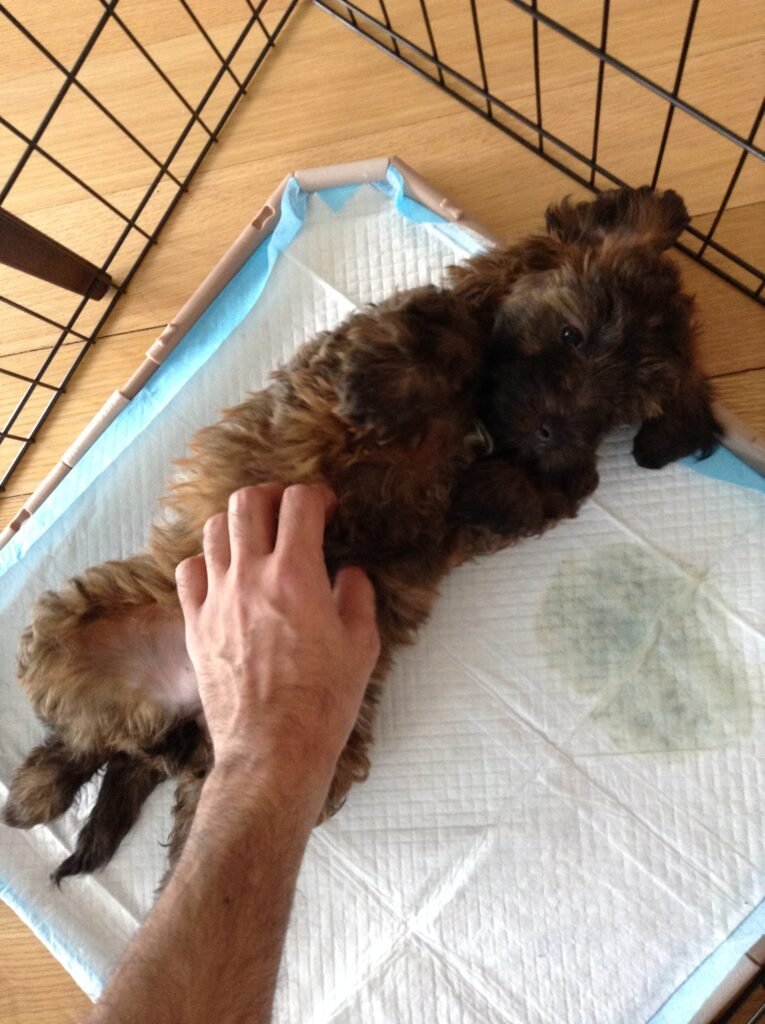
There are honest exceptions. A toy breed twenty floors up. An owner with limited mobility. A brutal Chicago January and a tiny puppy who has no business standing on road salt for ten minutes. In cases like those, a pad or an indoor grass patch by the door is a fair bridge. Put it in one fixed spot and plan to phase it out. If you are weighing pads against turf or a porch potty box for that bridge period, we compare all four setups directly in our indoor dog potty options for apartments guide.
A schedule that actually fits a workday
Puppies need to go out far more often than new owners expect. The rough rule: an eight-week-old holds it for about two hours, and you add roughly an hour for every month of age. So a three-month-old gets you around three hours, give or take. Overnight they usually stretch longer, because they are asleep and still.
Build the day around the moments you can predict. Nearly every puppy needs to potty:
- Right after waking, every single time, naps included
- Within fifteen minutes of eating or a big drink
- After play or any burst of zoomies
- Before you leave, and the second you walk back in
So a realistic weekday: out first thing, breakfast, out again, a crate nap while you work the morning, a midday trip handled by you, a neighbor, a walker, or a quick run home at lunch, then an afternoon nap and trip, dinner, an evening walk, and one last call before bed. Stuck in an office with no way home? You need a dog walker or a friend at least once midday for the first few months. No clever trick gets you out of it. The bladder is the bladder.
The elevator problem
On a high floor, the ride down is dead time your puppy’s bladder ignores completely. Carry a small dog for the first few weeks so the trip does not end on the lobby tile. Then pick one exit and one patch of curb or grass and use it every single time, because the scent of the last visit is the strongest cue your puppy has. Dogs read the ground like a bulletin board.
What to actually do at the curb
Take the puppy to the same spot, stand still, and be deeply boring. No walking, no playing, no chatting with the neighbor yet. The puppy needs to learn that the walk and the fun come after the job is done. Give it a few minutes. The instant they finish, praise like they cured something and hand over a small treat right there on the spot, not back upstairs. The reward has to land within a second or two of the deed, or the connection blurs.
Pick a phrase and stick with it. “Go potty,” “hurry up,” whatever you like, but say it as they start to go, not before. A couple of weeks in, that phrase turns into a cue you can use on a freezing morning when you are in a rush, and it earns every bit of its keep.
Accidents will happen. Handle them like an adult.
Your puppy will pee on the floor. More than once on a bad day, probably. Rubbing their nose in it teaches one thing only, that you are scary and hard to predict, and a puppy who fears you learns to potty in secret behind the couch, which is worse than the puddle ever was. Catch them mid-stream and it is a calm “ah-ah,” a scoop, and a quick trip outside to finish. Find a puddle after the fact and you just clean it. They cannot link a puddle from twenty minutes ago to your face right now.
Clean with an enzyme cleaner, not the regular floor spray. This is the step people skip, then wonder why the puppy keeps returning to the same corner. Ordinary cleaners hide the smell from you and leave the marker the dog still smells. Enzyme cleaners break down the actual compounds. A bottle runs maybe ten to fifteen dollars and saves you a month of repeat accidents in the same spot.
Crates, confinement, and why they help indoors
Dogs avoid soiling where they sleep. A crate sized so the puppy can stand, turn, and lie down, and not much more, puts that instinct to work. Too roomy and they will potty in one end and nap in the other, which defeats the entire point. Many crates ship with a divider so you can grow the space as the puppy grows.
The crate is not a storage box. It is a nap spot and a way to head off the unsupervised wandering that leads to puddles you never see starting. When you cannot watch the puppy with full attention, that is exactly when accidents appear. A crate, a playpen, or a puppy clipped to a leash on your belt closes that gap. For more on getting a young dog comfortable with alone time, our pieces on apartment living and daily care go deeper.
When to worry
Most puppies are reliably trained somewhere between four and six months, with the odd one taking longer. Small breeds often need a bit more time, partly because of tiny bladders, partly because a small puddle is easy to miss and reward by accident. If a puppy who was doing well suddenly backslides, or strains, or goes very often in tiny amounts, that can be a urinary tract infection, and a vet visit, often in the $100 to $250 range for the exam and a urine test, settles it fast. Do not train through a medical problem.
FAQ
How long does it take to potty train a puppy in an apartment?
Most puppies are largely reliable by four to six months with consistent trips outside, though full accident-free status can take a little longer for toy breeds. Expect more frequent accidents in the first month simply because of the distance to grass.
Should I use pee pads in an apartment?
Only if you genuinely can’t manage frequent trips outside, such as a very high floor with a tiny puppy or limited mobility. Pads teach a dog that indoors is acceptable, which you’ll later have to undo, so use them as a temporary bridge in one fixed spot.
How often does a puppy need to go out?
A rough guide is one hour of holding per month of age, so a two-month-old needs a trip about every two hours during the day, plus after every meal, nap, and play session. Overnight they can usually hold longer.
Why does my puppy keep peeing in the same spot indoors?
The previous accident left a scent marker that ordinary cleaners don’t remove. Clean the area with an enzyme-based cleaner so the dog can no longer smell the spot as a bathroom, and block access to it while training.
Can I potty train a puppy if I work full time?
Yes, but you’ll need someone to take the puppy out at least once midday for the first few months, whether that’s you on a lunch break, a neighbor, or a dog walker. A young puppy physically cannot hold it through a full eight-hour day.
Frequently asked questions
When can my puppy go outside safely?
For walks in public areas, wait until about a week after the final vaccine round, usually around 16 weeks. You can still socialize earlier in safe, clean spaces.
How do I potty train a puppy with no yard?
Use a consistent indoor pad or a balcony grass pad, take them out on a fixed schedule, and reward the moment they finish in the right spot.
How long can a puppy hold its bladder?
Roughly one hour per month of age. A three-month-old needs a break about every three hours, including overnight at first.