

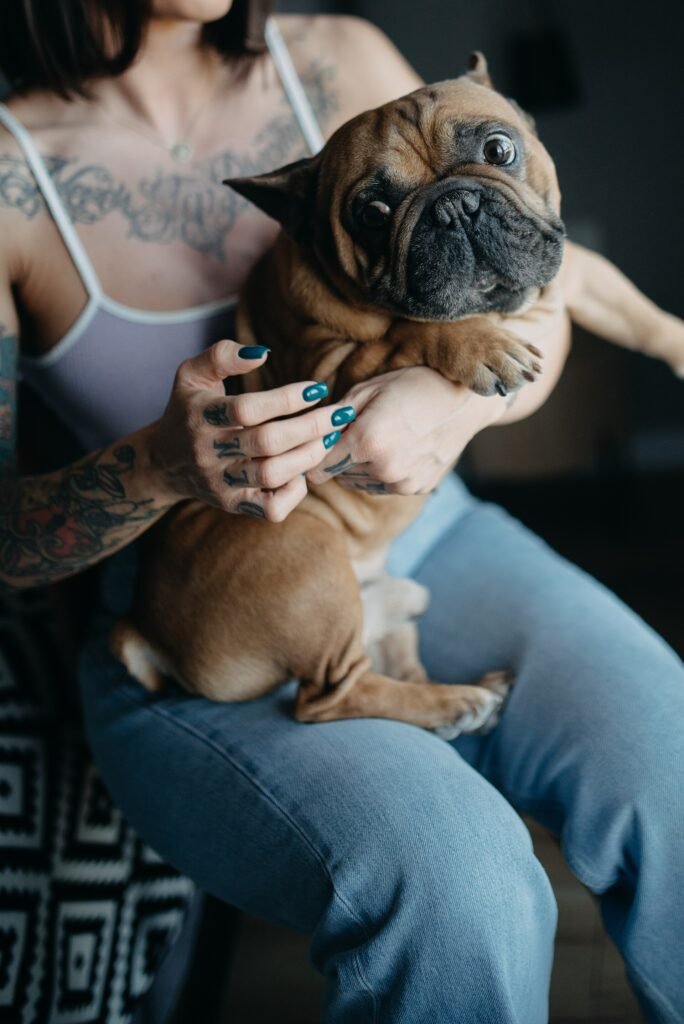
A quick note: a few links below are affiliate links. Buy through one and we may earn a small commission. It never costs you more, and we only point to gear we'd actually put in front of our own dogs. As an Amazon Associate I earn from qualifying purchases.
A dog takes the edge off a rough day and hands you joy for free. Having a friend who never tires of your company is one of the best parts of dog ownership. Still, you’ve probably caught yourself asking why does my dog sit on me?
Dogs share more with us than people expect. Loyalty is the obvious one. Ask anyone who’s had one.
What slips under the radar is that your dog picks up traits from you, and every breed brings its own temperament to the mix on top of that.
Before we get to the sitting, it helps to understand how dogs behave in the first place.
Dog Behavior
Like us, dogs are shaped by how they’re treated and how the people around them act.
Change the treatment and you change the behavior.
One study on dogs that lived through abuse and neglect found they tend to react with fear and hostility toward unfamiliar people and other dogs.
So where’s the line between normal dog behavior and the kind worth worrying about?
Normal Behavior
Dogs raised with steady care and affection, the things they need to grow up sound, tend to show behavior like this:
Wagging Their Tails
A wagging tail doesn’t always mean a happy dog. The tail is a real piece of his communication kit, and the height, speed, and stiffness of the wag each say something different in a dog’s body language.
Playfulness
Dogs come wired to move. They want walks, they run, they shred their toys, they buzz with energy. If yours suddenly slows down and pulls back from all of it, look at depression before you write it off as laziness. Plenty of owners in this exact spot also look into leash training a dog that pulls.
Barking
Animals can’t talk, but each one has its own way of getting a message across. Barking is how a dog talks to his person. The catch is that excessive barking isn’t a good sign.
Abnormal Behavior
People assume only mistreated dogs show unusual behavioral patterns. Well cared for dogs can show them too.
That doesn’t make them bratty or spoiled. There are plenty of reasons a dog acts the way he does.
First, though, you have to know what abnormal actually looks like. A few examples:
Compulsive Actions
Dogs get OCD much like people do. These actions show up as pacing, spinning after their own tail, and licking a leg raw.
Destructive Habits
Dogs run on energy, but when it boils over you have to step in. These habits look like chewing everything that isn’t a toy and excavating craters in your garden.
Possessiveness
A dog guarding his owner reads as sweet right up until someone gets bitten. An overprotective dog won’t think twice about going after whoever, or whatever, gets near his person. Training and a few other solutions can pull him back from guarding you so hard.
Reasons Why Your Dog Sits on You
Back to the question we started with. Why does a dog plant himself on his owner?
Nearly every dog does it at some point, so it lands squarely in the normal column, not the worrying one.
The explanations vary, but here are the ones we think best explain why your dog wants to share your seat.
1. Asserting Dominance
Dogs claim the top spot in all sorts of ways. Some bark, some growl, a few will square up to their own owners.
Owners love to read sitting as pure closeness, and miss that it can also be a dog quietly stating he’s in charge.
Dogs don’t flip overnight, so keep an eye out for other signs that he’s angling for control.
2. Jealousy
Yes, dogs get jealous over their people, much the way we do.
By sitting on you, your dog spreads his scent across you and posts a clear notice to other dogs: this human is spoken for.
He might even growl at another dog, or another person, from your lap. That’s jealousy, and it isn’t the only tell.
Other signs include picking fights with the other pets, getting needier than usual, and, you guessed it, crowding into your space.
It’s fixable, though. A few things help.
Don’t Give One Pet More Attention than the Other
With more than one pet at home, split your care and attention as evenly as you can.
Don’t crown a favorite, and don’t let either one slide into the background.
Animals feel emotions the same way we do, and being passed over stings.
Notice their Behavior
Watch how your dog handles other people and animals near you. Reward the calm, settled moments instead of the jealous ones, and you steer him toward the behavior you want.
Train Them More Often
Regular obedience work takes some of the heat out of jealousy.
If he’s jealous of one particular person, fold that person into your training sessions. It shows him there’s nothing to guard against.
3. Showing Affection
Nobody holds out against the soft, pleading eyes a dog gives you (and they never grow out of them) when a treat’s on the line.
Affection works the same way. Who turns down a dog who wants to show he’s crazy about you?
Dogs like to pour love on us the way we do on them, and parking on your lap is one of the loudest ways he says it.
4. Asking for Free Pets/Strokes
A reward is the high point of a dog’s day. He’ll trot out his manners or every trick he knows if it ends in a treat.
Food isn’t the only currency, though. A new chew toy works, and so does a good scratch in his favorite spot.
So he’ll curl into your lap and wait for your hand to start working through his coat, or his bare skin if he’s a hairless breed. It settles him more than you’d think.
Don’t overdo it, though. Too much petting can tip an already stressed dog into anxiety.
5. Offering Comfort
Dogs read us well. Happy, stressed, sick, sad, they pick up on it, and plenty of them clock you heading home before you’re through the door.
When something’s off, your dog may press into your side or climb onto your lap to offer what comfort he’s got.
He can’t hand you a tissue or rub your shoulders, sure. What he can do is sit in the bad day with you and give the only comfort he knows how to give.
Reading the Sit: Affection or Something Pushier?
Owners tend to lump every lap-sit into one warm category. In practice the same move can mean two very different things, and the difference is written all over the dog’s body. Learning to tell them apart in the moment is more useful than any single explanation, because it tells you whether to enjoy it or gently redirect it.
Watch what the rest of him is doing while he sits.
| What you see | Likely meaning | What to do |
|---|---|---|
| Loose body, soft eyes, sighs and settles, leans into your hand | Affection, comfort-seeking, plain coziness | Nothing. Enjoy it. |
| Faces away from you, scans the room, body relaxed | Guarding the doorway, on watch, feels safest with his back to you | Fine, but notice what he’s watching |
| Stiff, stares at another pet or person, low growl when they approach | Resource guarding or jealousy, not cuddling | Calmly move him off, work on training, don’t reward the growl |
| Sits on you only when you try to leave, paws or nudges constantly | Attention-seeking, sometimes early separation stress | Reward calm settling instead of the demand |
A concrete example. A reader wrote in about a 40-pound spaniel who’d climb onto her lap and go rigid every time her husband walked over, complete with a low rumble. That’s not love, that’s a dog guarding a resource, and the resource is her. The fix wasn’t to push the dog away. It was to have the husband become the source of good things, tossing treats and handling the walks, so the dog stopped seeing him as a threat to manage.
The flip side matters too. A dog who only piles onto you when there’s a thunderstorm, fireworks, or a suitcase by the door is telling you he’s stressed, not bossy. If the sitting is brand new, suddenly intense, or paired with trembling, panting, or hiding, that’s worth a word with your vet rather than a training tweak. New behavior in an older dog especially can have a medical root. If you want to dig into the difference between a clingy dog and a worried one, our guide on why a dog picks one person over another goes deeper on attachment versus anxiety.
Final Thoughts
A dog is about the best lifelong companion a person can ask for. Living with one teaches you to read behavior and to care for a creature whose needs run as deep as your own.
Hopefully you walk away with a clearer sense of why your dog keeps sitting on you.
These scruffy companions tell you they love you in far more ways than a wag or a happy spin at the door.
So the next time he drops his full weight onto your lap, take it for what it usually is. There aren’t many creatures that love you without conditions the way a dog does.
Google lets you pick which sites come up first in your own results.