


A quick note: a few links below are affiliate links. Buy through one and we may earn a small commission. It never costs you more, and we only point to gear we'd actually put in front of our own dogs. As an Amazon Associate I earn from qualifying purchases.
Quick answer
Yes, a Doberman does well in an apartment as long as it gets real daily exercise and is not left alone for long stretches. The reputation is mostly wrong: a Doberman is a velcro dog that follows you to the bathroom, sheds little and barks less than most guard breeds. What sinks it is boredom and, more often, the breed restrictions in your building, so read the lease before you pay a deposit.
Dobermans carry a reputation they mostly don’t deserve. People hear the name and picture a snarling guard dog straining at a fence. Spend a week with one and you meet something else entirely: a velcro dog that follows you to the bathroom and leans its full weight against your leg while you cook.
So can they actually live in an apartment?
Dobermans can be great apartment dogs as long as they get plenty of exercise and are given enough attention and quality time by their owners. They are very adaptable and loyal dogs with a friendly and loving personality.
Dobermans get compared to German shepherds a lot, and for apartment living the two breeds land in roughly the same category, plenty of exercise needed, but manageable with the right routine. See the full list of apartment-suited breeds for how they compare to smaller, lower-energy options.
The harder question is whether this breed fits your life, and whether you can give a 70 pound working dog what it needs inside four walls. That part is on you, not the dog.
What You Should Know About Living with a Doberman

The breed was created in the 1890s by a German tax collector who wanted a protective dog to walk his rounds. That history still shows. A Doberman watches the door, clocks who comes and goes, and bonds hard to its family.
Adults usually land between 60 and 100 pounds, with males on the heavier end. For all that muscle, they are people dogs first. They want to be near you, not patrolling a yard alone.
They are sharp, strong, and built to move. That intelligence cuts both ways. Socialize and train one early and you get a calm, steady companion. Skip that work and you get a big, anxious dog that makes its own decisions.
Is a Doberman a Good Family Dog?
Yes, and most people are surprised by how affectionate they turn out to be. They orient their whole day around their humans. Loyalty in this breed is not a marketing line, it’s the default setting.
They form tight bonds with the household and genuinely want to be part of whatever is happening. The protective streak comes free with that bond. A Doberman will put itself between its family and a perceived threat without being asked.
None of this happens by accident. Early socialization and training do the heavy lifting.
With kids they tend to do well, especially when raised alongside them from puppyhood. Still, this is a powerful dog. Supervise play with small children, and teach the dog and the kids how to read each other.
Do Dobermans Need a Lot of Exercise?
A lot, yes. This is a working breed, and a bored Doberman is a project you don’t want.
Plan on one to two hours of real activity every day. That keeps the body tired and the brain occupied, which is how you avoid the chewed baseboards and the barking that drives neighbors up the wall.
Apartment living only works if this box gets checked. No exercise, no calm dog. It’s that direct.
Walks do double duty. The movement burns energy, and the smells, sounds, and street traffic give the brain something to chew on. A Doberman that gets to sniff and look around comes home more settled than one marched in a straight line.
Two walks a day of 30 to 45 minutes each works well for most. Keep the pace up. A brisk trot does more than a slow amble where the dog stops every three feet.
Short daily walks beat a couple of marathon outings on the weekend. Consistency is what the body adapts to.
Try to keep the timing roughly steady too. Walking around the same hours each day gives your dog a rhythm to count on, and that predictability settles a lot of nerves.
Walks alone won’t cut it for this breed. Dobermans need bursts of higher intensity work on top of the daily loop.
Running and biking are both solid options. With their stamina, Dobermans make excellent running partners and can hold a steady pace over real distance once they’re grown.
Then there’s the mind. A Doberman needs mental work as much as physical, and tired legs with a bored brain still gets you into trouble. A few ways to keep the head busy:
- Puzzle Toys
- Chew Toys
- Scent Games
Are Dobermans Easy to Train?
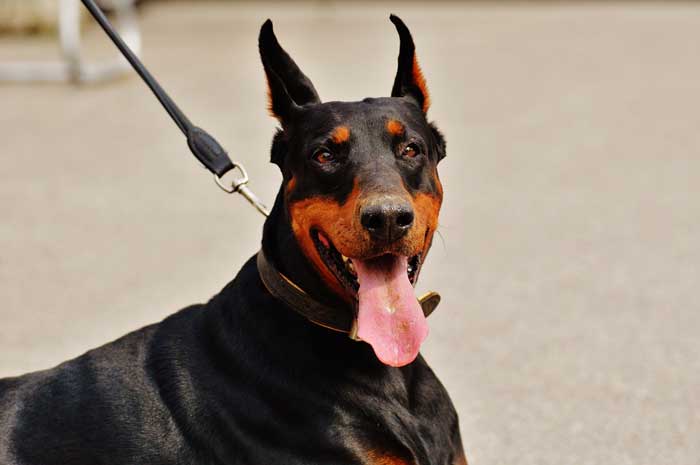
Few breeds pick things up faster. They’re smart, alert, and they want to please you, which is most of the battle.
Start the day your dog walks through the door. The common mistake is waiting a few months until the puppy “settles in.” By then it has already learned a pile of habits you now have to undo.
Dobermans can push for control, so a big part of training is showing your dog that you set the rules. Be the calm, confident one in the room. Steady beats loud every time.
That doesn’t mean getting rough. Harsh corrections and physical punishment tend to backfire with this breed, turning a confident dog into a jumpy one.
Positive reinforcement is where they shine. Reward the behavior you want with treats and praise, and let the bad stuff fade out instead of punishing it.
The whole thing comes down to two words: consistent and patient.
Are Dobermans Hard to Potty Train?
Not really. They’re smart enough to connect the dots quickly, and positive reinforcement speeds it up.
To potty train your Doberman in an apartment the key is getting him outside on a regular schedule.
Pick a spot close to the building, ideally on grass. Dogs build a preference for one surface, so the texture under their feet matters more than you’d think.
Puppies usually need to go every hour or two. Expect a lot of trips up and down in those first weeks. As your dog grows and his bladder catches up, the trips space out on their own.
The point is simple: give him the chance to go in the right place, then reward him the second he does.
Accidents inside are part of the deal early on. Nobody skips that stage.
Catch him mid-accident and scoop him outside to finish in the right spot, then reward him there. Timing is everything here.
Find an accident after the fact and there’s no point scolding him. He won’t connect the mess to the telling-off. Just clean it with an enzymatic cleaner so no scent is left to pull him back to the same spot.
Can Dobermans Be Left Alone?
They’d rather not be. These are companionship dogs through and through. That said, they handle alone time better than a lot of breeds once they’re trained for it.
A puppy shouldn’t be left more than about four hours, and a lot of that comes down to bladder limits at that age.
A trained adult with enough daily exercise can usually manage up to eight hours. The exercise part is not optional. A dog with no outlet and eight empty hours finds its own entertainment.
A few things that make alone time easier:
- Make sure your dog gets plenty of exercise before being left alone. A tired Doberman will be calmer and will spend most of the time just resting.
- Leave plenty of chew and mentally stimulating toys within his reach to keep him entertained and so he doesn’t start chewing on things he shouldn’t.
- Ask a friend or family member to visit your dog in the middle of the day to play with him and take him for a walk and go to the bathroom.
- Look for professional services of Dog Walkers and Dog Sitters.
- Take your Doberman to a Doggie Daycare where he can spend the time playing with other dogs.
Do Dobermans Bark a Lot?
Not by nature. They aren’t yappy dogs. But the guard dog wiring is still in there, so they’ll sound off when something near the door reads as a threat.
Beyond the alert bark, a Doberman often barks because it wants to tell you something specific.
The usual culprits:
- To advise that he needs to go out to the bathroom.
- To request attention from their owners when they feel neglected.
- Out of frustration and the need to release his large amount of energy due to insufficient exercise.
Do Dobermans Need to Be Groomed?
This is one of the easiest coats you’ll ever own. A quick brush once a week covers it, and baths only happen when he’s actually dirty.
They shed, but only moderately, and regular brushing keeps the loose hair off your couch.
Past that, trim the nails if they aren’t wearing down on their own, and brush his teeth often to keep the breath and the gums in good shape.
Is a Doberman a Good Apartment Dog?

It can work, and it works more often than people expect, provided the dog gets enough exercise, real socialization, and consistent training.
A few traits put Dobermans on the short list of good large apartment dogs:
- They are intelligent dogs, eager to please, and easy to train. This allows them to be well-behaved dogs that learn quickly what is expected of them.
- They are dogs that love to be with their people all the time. They do better and feel more secure when they feel part of the pack, and apartment life makes this easier.
- They are very clean dogs that don’t shed a lot and need little grooming.
- They are very adaptable dogs that develop well in various environments and situations.
- They are dogs with a friendly, affectionate and loyal personality
Tips for Raising a Doberman in an Apartment
Check the Breed Restrictions of Your Apartment
Plenty of buildings keep a banned breed list. The dog gets shut out before it’s ever met, usually over a reputation for being dangerous, loud, or hard to handle.
Dobermans land on those lists often. It’s frustrating and mostly unfair, but it’s the reality you’re working with.
Breed bans aren’t the only catch either. Buildings also set limits on size, weight, and sometimes the dog’s age.
So make the call before you fall in love with a puppy. Ask your landlord or property manager exactly what the building allows, in writing if you can get it.
Early Socialization Is Essential
If you do one thing right with a Doberman, make it this. A well-tempered adult almost always traces back to a puppy that got out and met the world.
Skip it and the breed’s protective edge curdles. An under-socialized Doberman grows up suspicious, fearful, sometimes flat-out aggressive.
Socialization just means exposure: new places, new noises, new situations, all while the dog is young and soaking it up.
Get him around as many people, kids, and animals as you safely can. Variety is the whole point.
Done right, it hands your dog a toolkit. He learns to read a situation and respond like a normal dog instead of panicking or guarding.
Dog-to-dog time matters most of all. That’s how a puppy learns canine body language and how to behave around its own kind, lessons no human can teach him.
Establish a Daily Routine From the Beginning
Dobermans, like most dogs, settle when the day is predictable.
A steady routine pays off in more ways than one.
The biggest one is security. A dog that knows what comes next worries less, and a calmer dog is a more confident dog. Stress feeds on the unknown.
Build the day around meals, potty breaks, play, and exercise.
- Mealtime. You have to feed your dog around the same hours of the day. This is important because it influences other aspects of the day, such as potty breaks.
- Potty Breaks. Living in an apartment taking your dog out to the bathroom is an essential part of their daily care. It is necessary to take it out first thing in the morning, before leaving for work and immediately after returning home. It is also recommended that you have a potty break after each meal, before bedtime and if possible in the middle of the day.
- Exercise and Playtime. Physical activity, both exercise and playtime are essential to the well-being of a Doberman. When a dog has his exercise routines around the same hours, he learns to distribute his energy throughout the day and use as much time as he can to rest and sleep.
Control Your Doberman’s Barking
In an apartment, barking is a neighbor problem fast. And a Doberman’s bark carries. It’s deep, loud, and impossible to ignore through a shared wall.
They’re alert by design, so even a quiet breed like this fires off at footsteps in the hall or a stranger pausing by your door. The trigger is everything moving past on the other side.
You can’t switch barking off completely, but you can keep it in check.
Most excessive barking traces back to one root cause: too little exercise, or a dog left to its own devices.
Dobermans need attention and a real outlet for their energy. Wear them out and spend time with them, and the nuisance barking mostly takes care of itself.
One reliable method is teaching the “Speak” and “Quiet” commands as a pair:
- Put your dog in a situation or do something that will make him bark.
- As soon as your dog starts barking, say the command “speak” in a calm, firm voice and give him a treat right away. Regularly practice these points until your dog barks when asked.
- Ask your dog to start barking and wait for him to be quiet.
- As soon as your dog is silent, say the “quiet” command and treat him immediately.
- When he starts to master it, gradually extend the time you say “quiet” and when you treat him.
- Practice regularly until your dog stops barking when you command it.
Find a Good Dog Park Nearby
Scout out a dog park close to home and make it a regular stop.
The value is the company. It’s open ground where your dog gets to socialize with other dogs, the kind of contact an apartment can’t provide.
It’s also room to open up. A breed this athletic needs space to flat-out run and play until the tank is empty, and a fenced park gives you that.
Just vet the place first. You want it securely fenced so nobody bolts, with well-socialized dogs and owners who actually watch them.
Final Thoughts
The Doberman is a low maintenance dog on the grooming front, but that’s not the same as an easy dog. This isn’t a breed for a first-time owner.
It’s a big, sharp working dog that needs real time and effort to grow into a healthy, balanced adult. Give that, and you’ve answered the apartment question.
Do the exercise, the training, and the socialization, and a Doberman becomes one of the best roommates you’ll share a small space with. Cut corners on any of the three and the same dog becomes a handful. The breed doesn’t meet you halfway. It mirrors the work you put in.
Resources
- Living With a Dobe by DPCA
- Doberman Pinscher (Dobie): Dog Profile by The Spruce Pets
Frequently asked questions
Are Dobermans good with kids?
Usually, yes, especially when they are raised alongside children. They are large and strong, so always supervise them around small kids.
Can a Doberman live in an apartment?
Yes, with enough exercise and attention. Plan 1 to 2 hours of activity a day plus some short bursts of running.
How long can a Doberman be left alone?
A puppy should be left alone for no more than about 4 hours. A trained adult can handle up to 8 hours.
Do Dobermans bark a lot?
Their bark is deep and carries far. Teaching a quiet command early keeps the neighbors happy.
Are Dobermans high maintenance?
Their grooming is easy, but their need for exercise and company is high. Expect daily time, not just a quick walk.
Google lets you pick which sites come up first in your own results.