

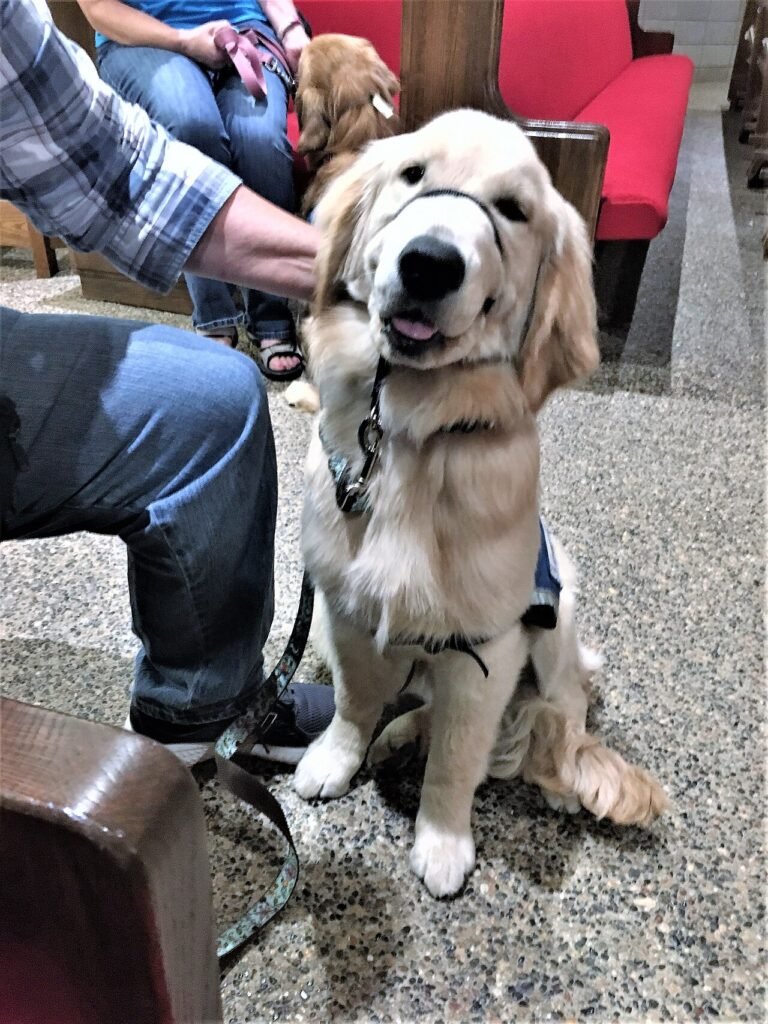
A quick note: a few links below are affiliate links. Buy through one and we may earn a small commission. It never costs you more. As an Amazon Associate I earn from qualifying purchases.
Under the Americans with Disabilities Act, a service dog for anxiety has to be a dog “individually trained to do work or perform tasks for an individual with a disability,” and the task must be directly related to that disability. The ADA service animal FAQ says that emotional support, therapy, comfort and companion animals are not service animals under the ADA, because they have not been trained to perform a specific job or task. The line between the two is the training, not the diagnosis and not the paperwork.
What the ADA definition requires
Only dogs qualify. The ADA 2010 requirements page also says service animals are working animals, not pets. The work or task has to be tied to the person’s disability. A dog that has been taught to open a door for a handler who uses a wheelchair meets the test, and so does a dog trained for a psychiatric disability, as long as the task is real and trained.
The ADA gives examples for mental health. Among the tasks it names are “reminding a person with mental illness to take prescribed medications” and “calming a person with Post Traumatic Stress Disorder (PTSD) during an anxiety attack.” Those are actions the dog performs on cue or in response to a trained signal.
Anxiety: when a dog qualifies and when it does not
The FAQ has a specific question about this. Whether a dog qualifies for someone with anxiety depends. If the dog has been trained to sense that an anxiety attack is about to happen and take a specific action to help avoid it or lessen its impact, it qualifies as a service animal. If its mere presence provides comfort, it does not. A dog you love, and that makes you feel better by being near you, is a wonderful thing to have. Under the ADA, it is not a service animal.
| Service dog | Emotional support animal | |
|---|---|---|
| Trained to perform a task related to a disability | Yes, by definition | No |
| Covered as a service animal by the ADA | Yes | No (ADA FAQ) |
| Comfort from presence alone | Not enough on its own for ADA purposes | The basis of the role |
| Certification required | No | Not applicable under the ADA |
The FAQ adds that some state or local laws may let emotional support animals into public places. That is a separate question from the ADA, and it varies by place, so check your own state and city before assuming either way.
What businesses can ask, and what they cannot
Staff may ask only two questions. First, is the dog a service animal required because of a disability? Second, what work or task has the dog been trained to perform? They may not ask for documentation, require a demonstration of the task, or inquire about the disability.
No vest, ID tag or harness is required. The handler is responsible for caring for the dog. The dog must be under control at all times and harnessed, leashed or tethered, unless those devices interfere with the dog’s work or the person’s disability prevents using them. A dog that is out of control, or that poses a direct threat, may be excluded.
Certification and registration
There is no certification requirement. The FAQ says online certification or registration documents convey no rights under the ADA, and that the Department of Justice does not recognize them as proof that a dog is a service animal. It also says mandatory registration of service animals is not permissible. Voluntary registries are allowed, but nothing about joining one changes a dog’s status.
Service animals are not exempt from everything. They remain subject to local dog licensing and vaccination rules. If you are building a training foundation for any dog in a city, our guide to calming a dog with anxiety covers the pet side of the question.
Housing is a different law
The ADA definition does not limit the broader category called “assistance animal” under the Fair Housing Act. The FAQ says: “Under the Fair Housing Act, housing providers are obligated to permit, as a reasonable accommodation, the use of animals that work, provide assistance, or perform tasks that benefit persons with disabilities, or provide emotional support to alleviate a symptom or effect of a disability.” That is why a dog that does not meet the ADA test for a store may still be relevant when renting.
The guidance on how that works has been in flux. A HUD memorandum dated September 17, 2025, titled “Notice of the Withdrawal of FHEO Guidance Documents,” withdrew FHEO Notice 2013-01 on service animals and assistance animals in housing, and FHEO 2020-01 on assessing a request for an animal as a reasonable accommodation. The memorandum says the withdrawal “is not necessarily final” and that the withdrawn guidance “should not be relied upon as authoritative.” Guidance documents are non-binding, but the practical effect is that older checklists you find online may no longer reflect what HUD says. Check current rules before you rely on one, and consider asking a housing lawyer or a local fair housing organization.
When to talk to a professional
The ADA sources describe the legal definition only. They do not say whether a dog is right for your condition, how to train one or how long training takes. A clinician who knows your history can speak to whether a trained dog would help, and a qualified trainer can speak to what the dog can be taught. If anxiety is making daily life hard right now, that conversation should not wait on a dog.
Common questions about service dogs for anxiety
Can a dog be a service animal for anxiety?
The ADA FAQ says it depends. If the dog is trained to sense an oncoming anxiety attack and take a specific action to help avoid it or lessen its impact, it qualifies. If its presence alone is the comfort, it does not.
Do I need to register or certify my service dog?
No. The ADA FAQ says there is no certification requirement, that online certificates convey no rights, and that mandatory registration is not permissible.
Does my service dog have to wear a vest?
No. The ADA FAQ says no vest, ID tag or harness is required.
Can a store make me prove my dog is a service animal?
Staff may ask only two questions: whether the dog is required because of a disability, and what work or task it has been trained to perform. They may not ask for documents or a demonstration.
Is the housing definition the same as the ADA definition?
No. The ADA FAQ says its definition does not limit the broader assistance animal definition under the Fair Housing Act. HUD withdrew related guidance in 2025, so check current rules or ask a housing lawyer.
Google lets you pick which sites come up first in your own results.