
A quick note: a few links below are affiliate links. Buy through one and we may earn a small commission. It never costs you more. As an Amazon Associate I earn from qualifying purchases.
A food toy can help a dog with separation anxiety, but only inside a plan, and only for the right dog. The ASPCA says food puzzle toys and chew items encourage chewing and licking, which “have been shown to have a calming effect on dogs,” and recommends providing them whenever you leave your dog alone. It also says a moderate or severe case needs a structured program run with a trained, experienced professional. A toy is one tool in that program. It does not stand in for it.
First, make sure it is separation anxiety
The ASPCA says to rule out medical problems before treating a dog for separation anxiety, and it mentions incontinence and medications that cause frequent urination as examples. It also separates separation anxiety from boredom. A bored dog usually does not look anxious, and the fix for boredom is different. Our article on separation anxiety or boredom goes through how to tell them apart.
This matters for toys because a toy that solves boredom may do nothing for a panicking dog. If the dog will not touch the toy when you leave, that is information, and the next section explains what it means.
How food toys fit into the plan
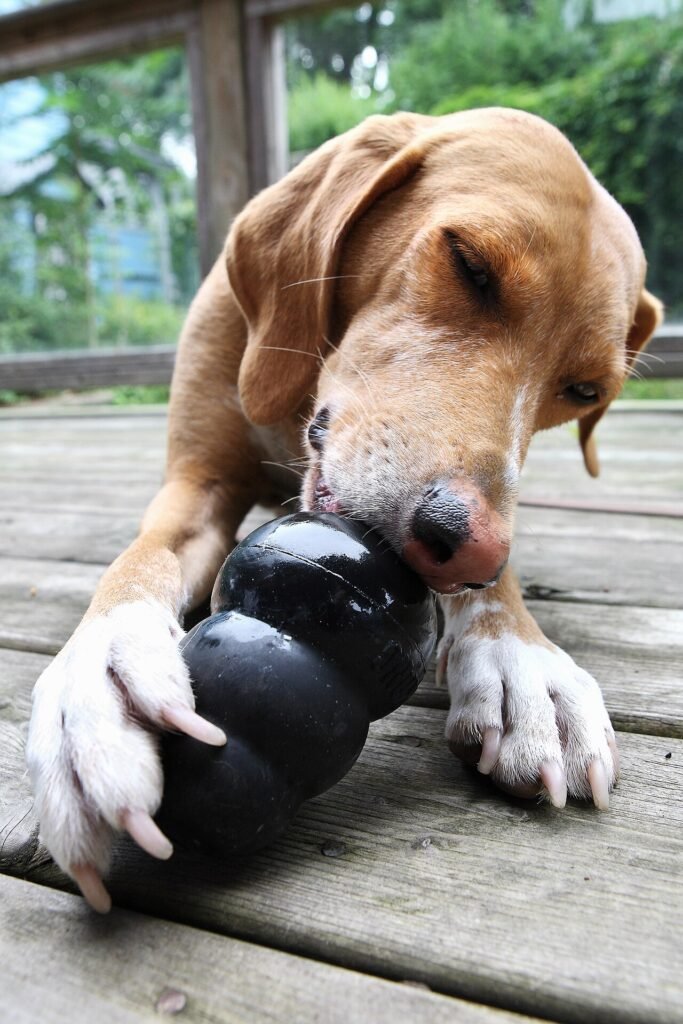
The ASPCA describes a use that goes beyond keeping a dog busy. Once your absences reach 5 to 10 seconds in a counterconditioning program, give a stuffed food toy just before stepping out. It works as a safety cue that tells the dog the separation is “safe.” Then remove the special toys as soon as you come home, so the dog only has them when alone. A toy that is always on the floor stops being special.
The ASPCA names stuffing ideas for a hollow toy: low-fat cream cheese, low-fat peanut butter, frozen banana with cottage cheese, or canned dog food mixed with kibble. The stuffed toy can be frozen so it takes longer to finish. The ASPCA also says meals can be fed in special toys, which turns a daily feeding into part of the routine.
AAHA’s canine separation anxiety toolkit adds a way to read the result. It suggests offering food toys when you are at home first, then when the dog is alone if it uses them. If the dog eats the food from the toy while you are out, anxiety is lessening. AAHA also says: “Dogs that are extremely distressed cannot eat.” An untouched toy is a sign, not a failure of the toy, and AAHA says to decide at a recheck whether food toys are helping.
Types of toys to look at
| Type | What the sources say | Use with care |
|---|---|---|
| Hollow chew toys you stuff | ASPCA describes stuffing with low-fat fillings and freezing | Only for a dog that will eat while alone |
| Food puzzle toys | ASPCA says they encourage chewing and licking, which calms dogs | Feeding meals this way is an ASPCA suggestion |
| Chew items | Same ASPCA statement on calming effect | The ASPCA gives no product guidance |
| Silicone lick mat | Cornell lists one for a quiet area during a stressful event | Cornell describes it for holidays, not for separation anxiety |
The first row carries the condition that matters. If you can see from a camera that your dog does not eat, put the toy away and talk to your vet instead of buying a bigger or fancier one. The sources do not support the idea that a better toy fixes a dog that is too upset to eat.
For heavy chewers, a tough toy matters for a different reason. Our guide to chew toys for heavy chewers is a place to start, but the ASPCA does not rank products, and neither does this article.
Exercise, routine and the rest of the plan
The ASPCA also lists physical and mental stimulation as helpful. It does not give a number of minutes, so any fixed figure you see elsewhere is not coming from this page. Cornell’s holiday page recommends a silicone lick mat, among other things, for a dog in a quiet area, which is the same principle at a smaller scale: something to lick while the world is loud.
If you want a step-by-step schedule for building up absences, this graduated plan for apartment life lays one out. The toy goes in at the stage where your absences are measured in seconds.
What the first weeks can look like
Putting the ASPCA and AAHA pieces in order gives a rough sequence. First, rule out medical causes and, if the case is moderate or severe, find the professional. Next, practice very short absences. When you reach the point where you are gone for 5 to 10 seconds, hand over the stuffed toy just before you step out, then pick it up when you come back. Offer food toys while you are home before you rely on them while you are away, as AAHA suggests, so the dog learns what they are.
Then watch what happens. A dog that eats while you are out is telling you the anxiety is easing. A dog that ignores the toy is telling you the step was too big. Neither source gives a schedule in days or weeks, so let the dog’s behavior set the pace, and take the pattern to your vet at the recheck AAHA describes.
When to call the vet or a professional
Dogs with separation anxiety who try to escape or destroy things can injure themselves. The ASPCA lists broken teeth, cut paws and damaged nails. If you see injuries, or your dog hurts itself getting out of a crate or through a door, call a vet. AAHA says panic may call for medication, as decided by the vet, and that a qualified person should coach desensitization and counterconditioning. If your dog will not eat or settle at all when you leave, treat that as a reason to book a visit, not to keep trying new toys.
Common questions about toys for separation anxiety
Do toys cure separation anxiety?
No. The ASPCA says moderate or severe cases need a complex desensitization and counterconditioning program with a trained, experienced professional.
What can I put inside a hollow toy?
The ASPCA suggests low-fat cream cheese, low-fat peanut butter, frozen banana and cottage cheese, or canned dog food and kibble. It says the toy can be frozen so it lasts longer.
My dog ignores the toy when I leave. Why?
AAHA says dogs that are extremely distressed cannot eat. If the dog eats from the toy, anxiety is lessening. If not, ask the vet at a recheck.
Should the toy stay out all day?
The ASPCA says to remove the special toys when you return home, so the dog only has them when alone.
Frequently asked questions
How long can I leave my dog home alone?
An adult dog can manage about 6 to 8 hours. Puppies need a break every 2 to 4 hours. Beyond that, plan a walker or daycare.
How do I keep my dog busy while I am at work?
Leave a stuffed puzzle feeder or a long-lasting chew, a comfortable spot by a window, and some background sound. A real walk first helps them settle.
Is it separation anxiety or just boredom?
Boredom looks like chewing and mess. True separation anxiety shows panic, drooling and distress within minutes of you leaving, and needs a gradual desensitizing plan.
Google lets you pick which sites come up first in your own results.