

A quick note: a few links below are affiliate links. Buy through one and we may earn a small commission. It never costs you more, and we only point to gear we'd actually put in front of our own dogs. As an Amazon Associate I earn from qualifying purchases.
There’s a specific sound a heavy chewer makes about ninety seconds after you hand over a new toy, and every owner of one knows it: the pop of a seam giving way. Then the slow, methodical work of extracting whatever is inside. You bought a toy. The dog received a puzzle with a solution, and it solved it before you finished making coffee.
The pet industry has a word for these dogs, “power chewers”, and a pricing strategy to match, which is that you will buy toys forever. You can get off that treadmill, but not by finding the one indestructible object. It doesn’t exist. What exists is a set of rules about what a dog can safely destroy, how fast, and what happens to the pieces.
Destructible is fine. Swallowable is not.
The failure mode owners fear is the toy breaking. The failure mode that actually sends dogs to surgery is a toy that breaks into pieces the dog can get down. Those are different problems, and optimizing for the first one can make the second one worse.
Very hard toys (nylon bones, hard plastic, natural antlers, hooves, real bones) resist destruction by being harder than the dog’s teeth. That’s the design. It’s also the mechanism by which they crack teeth. The slab fracture of the upper fourth premolar is common enough in veterinary dentistry to be almost a signature injury, and repairing one runs well into four figures. The standard rule of thumb: if you can’t dent it with a thumbnail, and it wouldn’t hurt to be hit on the kneecap with it, it’s too hard for a dog’s mouth.
Soft toys with squeakers and stuffing fail the other way. A determined chewer opens one in minutes, and the squeaker and the polyfill go down. Polyfill in particular is genuinely dangerous, because it’s radiolucent (it doesn’t show up on an X-ray), so a dog with an obstruction from stuffing can present with a clean film and a surgeon guessing.
The useful zone is in between: firm rubber that gives under pressure, sized so the dog can’t get it behind the molars, and that fails by abrading into small crumbs rather than splitting into chunks. Natural rubber compounds do this. So do the thermoplastic elastomers used by the better American manufacturers. When those toys wear out, they get visibly pitted and shaggy, which is your cue to bin them, not a sign you got a defective one.
Size up. Then size up again.
The single most common mistake I see is buying to the dog’s body size rather than its jaw. A 45-pound dog with a broad head and a serious bite can flatten a toy rated for its weight class. Go a size above what the packaging suggests. The toy should be too large to fit fully into the mouth, full stop. If the dog can get it past the canines and onto the back teeth, it now has leverage, and leverage is what breaks things.
This applies to balls with unnerving specificity. A ball that fits neatly at the back of a large dog’s throat can lodge there and seal the airway, and it happens to healthy dogs during ordinary play. Whatever ball you buy, it needs to be too big for that, and it needs an air hole through it.
Stuffable toys change the math
The reason hollow rubber toys have outlasted every trend in this category is that they convert chewing from a destruction task into a foraging task. A dog working peanut butter out of a cavity is not applying maximum force to the material; it’s licking and manipulating. The toy lasts, and the dog gets fifteen to forty minutes of the kind of mental work that actually tires it out.
Freeze them. A stuffed toy frozen overnight lasts three or four times longer than the same toy stuffed and handed over immediately, and the cold is soothing on a teething puppy’s gums. Wet kibble with a little plain yogurt or pumpkin, pack it in, freeze upright. In an apartment, this is the difference between a dog that settles during your afternoon meetings and one that doesn’t.
If your dog’s chewing is really boredom wearing a costume (and in apartments it very often is), the toy is only half the answer. Puzzle feeders and food-dispensing toys do more to reduce destructive chewing than any material upgrade, because they address why the dog is chewing rather than what it’s chewing on.
Rotate, don’t accumulate
A dog with eleven toys available at all times has no toys. Novelty is most of the appeal, and constant access burns it off. Keep four or five out, put the rest in a closet, and swap weekly. The toy that came back from the closet gets attacked like it’s new, which is both cheaper and more effective than buying another one.
Rotation also lets you inspect. Every swap is a chance to check for cracked edges, exposed rope core, missing chunks. Toys don’t get retired because someone decided to; they get retired because someone looked.
Rope, edible chews, and the things that hide in the gray zone
Rope toys are marketed for dental benefit and are a real obstruction risk with a heavy chewer. The fibers come loose in long strands, and long strands are the worst thing a dog can swallow, because they can bunch the intestine along their length. Linear foreign bodies are a specific and serious surgical problem. Rope for supervised tug, never for solo chewing, and gone the moment it starts fraying.
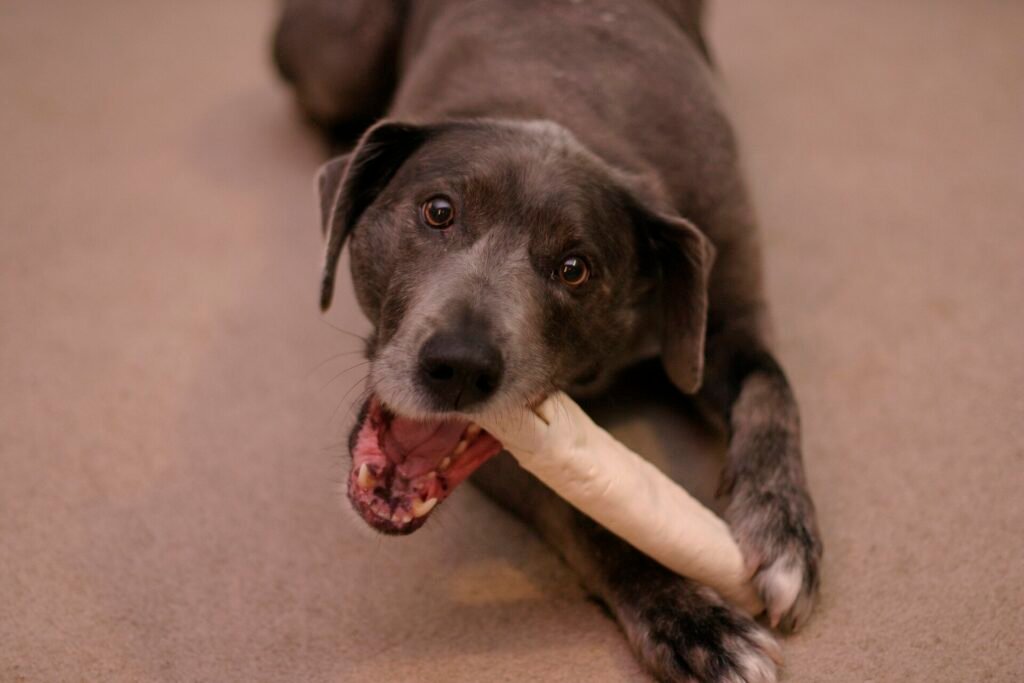
Edible chews sit in a different category, and their risk is dose rather than mechanics. Bully sticks, tracheas, and the various dried single-ingredient chews are digestible and satisfying, and they are also calorie bombs: a standard bully stick can carry 90 to 120 calories, which for a 20-pound apartment dog is a substantial share of the daily allowance. They’re a treat with a chewing benefit, not a way to occupy a dog every evening. Thickness is what you are actually paying for: a thin stick is gone in four minutes and a thick one runs forty, so the heavier cuts work out cheaper per quiet hour even at a worse price per stick. Whether they do anything for teeth is a separate question with a more complicated answer.
Antlers, hooves, and weight-bearing bones I’d skip entirely for the tooth-fracture reason above. Plenty of dogs chew them for years without incident. The ones that don’t get expensive.
When the chewing isn’t about toys at all
A dog that destroys toys is normal. A dog that destroys door frames, baseboards, and windowsills, specifically while you’re out, is telling you something else. That pattern (damage concentrated at exit points, happening only in your absence, often with drooling or vocalizing) is separation distress, not boredom, and no toy fixes it. The distinction between the two is worth getting right, because the interventions are completely different and the boredom playbook makes anxiety worse.
Age matters too. Puppies chew hardest between about four and seven months while adult teeth are coming in, and that intensity does fade. Adolescent dogs get a second surge around ten to fourteen months that surprises people who thought they were through it. Both are developmental. The dog you have at three years old chews far less than the one you have at eight months, which is genuinely worth knowing when you’re standing over a shredded rug at 6 a.m. wondering what you’ve done.
Frequently asked questions
Are nylon bones, antlers, and hooves safe for power chewers?
They resist destruction by being harder than the tooth, and that is exactly how slab fractures of the upper fourth premolar happen. The working test: if you cannot dent it with a thumbnail, and it would hurt to be hit on the kneecap with it, it is too hard for a dog mouth.
What size chew toy should I buy for a heavy chewer?
One size above the packaging recommendation, sized to the jaw rather than the body weight. The toy has to be too large to fit fully into the mouth. Once a dog can get it past the canines onto the back teeth it has leverage, and leverage is what breaks things.
Why does my dog destroy every toy in minutes?
Often it is under-stimulation rather than jaw strength. A hollow rubber toy packed with wet kibble and frozen overnight turns chewing into foraging and lasts three or four times longer, because the dog is licking and manipulating instead of applying maximum force.
Are rope toys safe for dogs that chew hard?
For supervised tug, yes. For solo chewing, no. The fibers come loose in long strands, and long strands can bunch the intestine along their length. Linear foreign bodies are a specific surgical problem, and a fraying rope should go in the bin the day it starts.
Google lets you pick which sites come up first in your own results.