

A quick note: a few links below are affiliate links. Buy through one and we may earn a small commission. It never costs you more, and we only point to gear we'd actually put in front of our own dogs. As an Amazon Associate I earn from qualifying purchases.
A tired dog is a quiet dog, and in an apartment with shared walls, quiet is the whole ballgame. But “tired” doesn’t have to mean a two-hour hike you don’t have time for on a Tuesday. Mental exhaustion works almost as well as physical exhaustion for a lot of dogs, and it takes a fraction of the time. Fifteen minutes of genuine problem-solving can tire a smart, bored dog out more than a lap around the block, which is exactly why puzzle toys punch so far above their size for apartment living.
My own dog, a border collie mix who has zero business living in a two-bedroom without a yard, goes from bouncing off the walls to flat-out asleep on the rug after about twenty minutes with a snuffle mat and a handful of kibble scattered into it. That’s not a fluke. It’s how a lot of working and herding breeds are wired, and it’s worth knowing before you assume your dog just “has too much energy” and needs more walks than your schedule allows.
Short on time? Jump straight to the Fresh Patch real-grass pad
Treat-dispensing toys
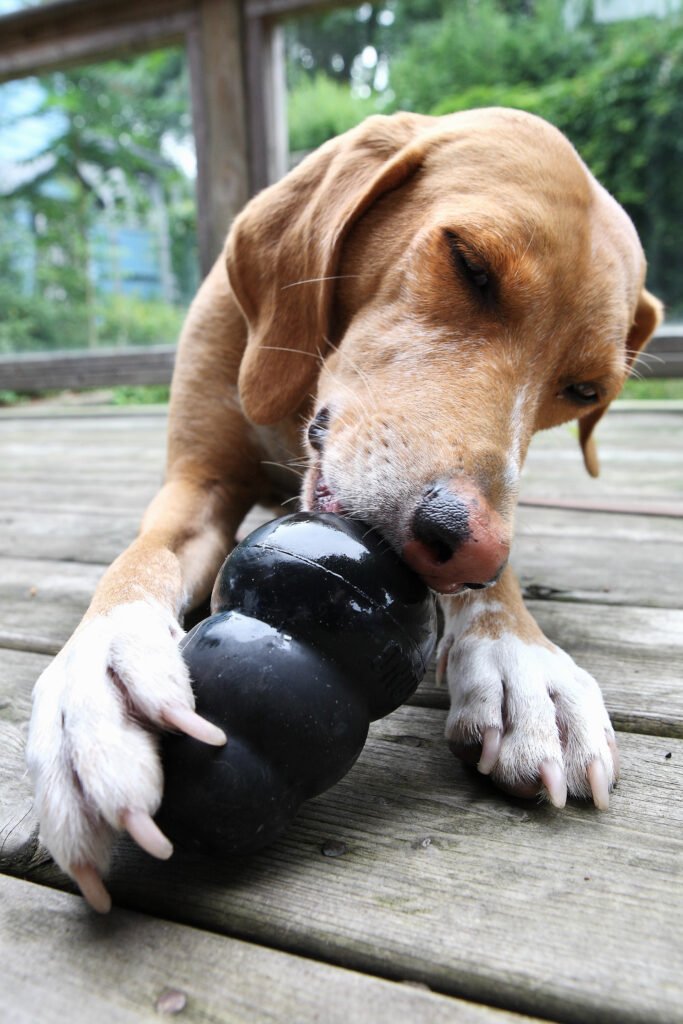
The category most people start with, and for good reason: a hollow rubber toy stuffed with kibble or peanut butter keeps a dog occupied through repeated licking and gnawing, which is a genuinely calming, almost meditative activity for most dogs, closer to what people mean when they talk about a dog “decompressing.” Freeze it after stuffing for a longer session, since frozen filling takes a dog considerably longer to work through than room-temperature filling.
The mistake most owners make is buying one size and sticking with it forever. A dog who’s mastered the easy version stops engaging, the same way a kid stops doing a puzzle they’ve already solved ten times. Rotate difficulty, not just toys, and if your dog empties a treat-dispensing dog toy in under two minutes, size up to a model with a smaller opening or more internal chambers before assuming the category doesn’t work for your dog.
Puzzle feeders
Structured boards or trays with sliding pieces, flip lids, or spinning discs that a dog has to manipulate with their nose or paw to reveal hidden treats. These require more focused problem-solving than a simple stuffed toy, and they’re the closest thing to actual cognitive work you can hand a dog without training equipment.
How do I know if a puzzle toy is too hard for my dog?
If your dog gives up and walks away within a minute or two without any treats released, it’s too hard and you’ll train frustration instead of engagement, which is the opposite of the goal. Start with a level 1 or beginner-rated puzzle even if it feels too easy, watch how fast they solve it, and move up only once a puzzle stops holding their attention. Most dogs progress through two or three difficulty levels within a month, faster than owners expect, so don’t overbuy the hardest version on day one assuming it’ll last longer.
Snuffle mats
A thick fabric mat with fleece strips tied densely enough that scattered kibble disappears into it, forcing a dog to use their nose to root it out piece by piece. This is scent work, not visual or manipulative problem-solving, and it taps into a completely different part of a dog’s brain than a treat-dispensing toy does. Scent-driven breeds, beagles, dachshunds, most hounds, tend to find this category more satisfying than any other, sometimes noticeably so compared to puzzle feeders.
Wash it regularly. A snuffle mat that’s absorbed weeks of kibble oil and drool starts smelling bad fast in a small apartment, and most are machine washable on a gentle cycle, so there’s no real excuse to skip it.
Matching the toy to what’s actually driving your dog’s boredom
Not all restlessness is the same problem, and buying the wrong category of toy for the wrong cause wastes money and doesn’t fix the barking, chewing, or pacing you’re actually trying to solve.
- Destructive chewing when left alone usually responds best to tough treat-dispensing toys that occupy the mouth specifically, not puzzle feeders that need supervision to be safe
- Excess barking at nothing often improves with scent work like snuffle mats, since it burns mental energy in a way that leaves a dog satisfied rather than keyed up
- General restlessness and pacing responds well to rotating two or three puzzle types so the dog never fully masters one and loses interest
If barking specifically is the problem you’re trying to solve and it’s tied to noise sensitivity rather than boredom, mental enrichment alone won’t fully fix it. Our dog barking by breed breakdown is worth checking to see whether your dog’s breed tends toward reactive barking versus boredom barking, since the fix looks different depending on which one you’re actually dealing with, and our guide on how to stop dog barking in an apartment covers the training side in more depth than a toy alone can.
Rotation beats accumulation
Owning ten puzzle toys and leaving them all out permanently is worse than owning three and rotating them weekly. Novelty is doing most of the work here, not the object itself. A toy that’s been sitting in the same spot for a month stops registering as interesting even if it’s technically still a challenge, the same way a familiar hallway stops getting sniffed the tenth time through. Put two away in a closet and swap them back in every week or two, and you’ll get noticeably more engagement out of the same three toys than you would leaving all ten scattered across the living room permanently.
If your dog also struggles with time alone rather than just boredom while you’re home, puzzle toys help but usually aren’t a complete fix on their own. Our guide on how long you can leave a dog alone covers the alone-time side of this specifically, including which enrichment tools hold up best across a full workday versus a quick errand.
Frequently asked questions
Can big dogs really live in an apartment?
Yes. Energy level matters far more than size. A calm Great Dane settles into a flat better than a wound-up terrier, as long as it gets a proper walk twice a day.
Which dog breeds bark the least in apartments?
Greyhounds, Basenjis, Bulldogs and Cavaliers are among the quietest. Any dog can learn to be calm, but these simply start at a lower volume.
How much exercise does an apartment dog need?
Most do well on 30 to 60 minutes a day split into two walks, plus a little indoor play. Cut that short and the barking and chewing usually start.
Google lets you pick which sites come up first in your own results.