

A quick note: a few links below are affiliate links. Buy through one and we may earn a small commission. It never costs you more, and we only point to gear we'd actually put in front of our own dogs. As an Amazon Associate I earn from qualifying purchases.
Nobody warns you that shedding is a spatial problem before it is a hair problem. In a house with a yard, a shedding dog distributes its coat across two thousand square feet and a lawn. In a 600-square-foot one-bedroom, the same dog puts the same volume of hair into a space where you also sleep, cook, and sit down with guests. The dog isn’t shedding more. The hair just has nowhere to go.
I’ve watched people try to fix this with a better vacuum, which helps at the margins, and with breed guilt, which helps not at all. The approach that actually works is boring: get the loose coat off the dog on a schedule, before it lands. Everything else is cleanup.
Shedding runs on daylight, not temperature
The seasonal blowout most owners dread is triggered by photoperiod, the number of daylight hours, not by how warm it is. This matters enormously indoors, because an apartment with the lights on until 11 p.m. and blackout curtains half the year gives a dog a confused signal. Plenty of indoor city dogs never get a clean spring and fall cycle at all. They shed a moderate amount continuously, all twelve months, which owners read as “my dog sheds constantly and something must be wrong.”
Usually nothing is wrong. A dog living under artificial light is doing exactly what its biology tells it to. The practical consequence is that you cannot wait for shedding season and then deal with it. There is no season. There is only Tuesday.
Match the tool to the coat, not to the reviews
Most brushing advice fails because it treats “dog coat” as one thing. It isn’t, and using the wrong tool ranges from useless to actively harmful.
Double coats (huskies, shepherds, corgis, Pomeranians, most northern breeds) have a coarse outer layer and a dense woolly undercoat. The undercoat is what carpets your apartment. An undercoat rake with rounded pins pulls it out; a slicker brush mostly rearranges the topcoat and makes you feel productive. On a shedding Pomeranian, twenty minutes with a rake will fill a grocery bag.
Short single coats (beagles, pugs, boxers, Frenchies) shed short, stiff hairs that weave into upholstery and are genuinely harder to remove from fabric than long hair. A rubber curry brush or grooming mitt in circular motions works better here than anything with pins. These dogs are also the ones people wrongly assume are low-shed because the hair is short.
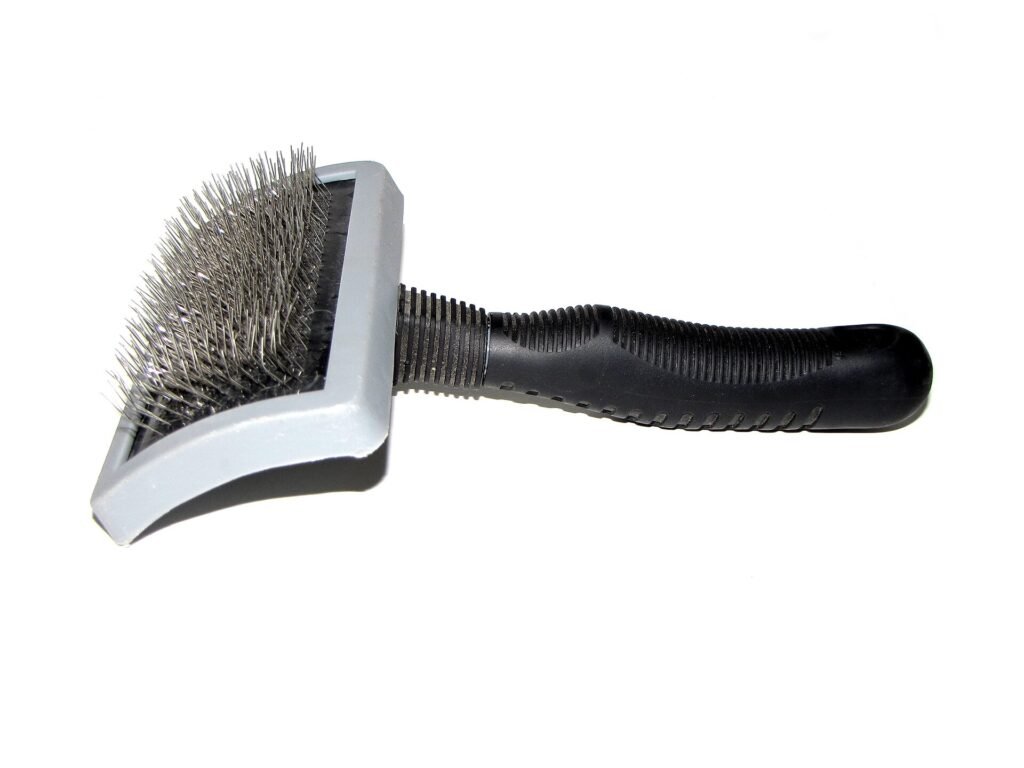
Long silky and curly coats (Shih Tzus, Yorkies, poodles, doodles) shed the least into your apartment but the most into their own coat, where it forms mats. A pin brush plus a metal comb, working in sections down to the skin. Skip the deshedding tools entirely; they cut the coat.
A word on the popular bladed deshedding tools: they work, and they are easy to overdo. The blade cuts hair as well as pulling loose hair, and used weekly on the same dog for a year you can visibly damage the topcoat. Once every two or three weeks during a heavy period, not as a daily habit.
Frequency beats duration
Five minutes daily removes more total hair from your apartment than forty-five minutes on Sunday. Loose hair sits in the coat for a limited window before mechanical friction (the dog scratching, rubbing against the couch, walking under the coffee table) releases it into the room. Get it in that window and it never becomes your problem.
Do it in the same place every time. A bathroom with the door shut is the single best room in an apartment for this, because the hard floor means the fallout sweeps up instead of embedding, and the confined space keeps the dog from wandering off mid-session. Fifteen minutes of daily brushing across a week beats any vacuum you can buy.
Bathing helps, and most people bathe wrong
A bath loosens dead hair in bulk, but only if you brush before and after. Bathing an unbrushed double-coated dog drives loose undercoat into a felted mass that then has to be worked out over days. Brush first, bathe, dry completely, brush again. The post-bath brush is where the volume comes out.
Every four to six weeks is a reasonable ceiling for most coats. More often than that with a stripping shampoo and you strip skin oils, the skin overcompensates, and you get flaking that looks like even more shedding. If your dog is scratching more after you increased bath frequency, that is the mechanism.
Drying matters more than owners think in a small apartment. A double-coated dog left to air-dry in a humid bathroom holds moisture against the skin for hours, which is how hot spots start. If you’re bathing at home, plan on a forced-air dryer or a very long towel session.
What the hair does once it’s airborne
Dog hair itself is heavy and falls fast. The thing that hangs in the air in an apartment is dander, the flakes of skin that come off with it, and dander is what makes guests with allergies react and what settles into a fine film on every surface you own. Vacuuming addresses the hair. It does very little for the airborne fraction, and a vacuum without a sealed HEPA path actively puts dander back into the room.
This is the one place where equipment genuinely changes the outcome. A unit sized for the actual room volume, running continuously on low rather than in bursts on high, is what keeps the film off the furniture; we compared the air purifiers that hold up in a real apartment with a dog, including the ones that are loud enough that you’ll turn them off and stop benefiting.
Fabric choices do a surprising amount of work too. Tightly woven, flat-weave upholstery releases hair; loose knits, chenille, and boucle trap it permanently. If you’re buying furniture while owning a shedding dog, run your hand across the sample in the store. If it grabs, it will grab hair for a decade.
Diet, and the limits of what a supplement can do
Omega-3 fatty acids improve coat quality and reduce breakage, which reduces the fraction of shedding that comes from a poor coat rather than the normal cycle. Fish oil at a dose your vet sets by body weight is a reasonable thing to add. What it will not do is stop a healthy dog from shedding, and any product marketed as doing that is lying to you.
Sudden changes are the signal worth acting on. A dog that starts shedding in patches, or whose coat thins symmetrically on both flanks, or who develops a dull greasy coat over a few weeks, is not having a grooming problem. Hypothyroidism, Cushing’s, flea allergy dermatitis, and food allergies all show up first as coat changes. Symmetrical loss especially: that pattern is endocrine until proven otherwise, and it needs bloodwork, not a better brush.
The thing you should not do
Do not shave a double-coated dog to reduce shedding. The undercoat is insulation that works in both directions; it keeps heat out in summer as much as it keeps heat in during winter. Shaved, the dog gets hotter, not cooler, and is exposed to sunburn. Worse, the undercoat frequently grows back faster and denser than the guard hairs, so the coat comes back patchy, coarser, and permanently worse at doing its job. Groomers see the result constantly and it does not fully reverse.
Single-coated dogs can be clipped without this problem. If you don’t know which yours is, ask a groomer before anyone touches it with clippers.
If you haven’t got the dog yet
All of the above is manageable. But if you’re still choosing, and you’re choosing for a small apartment, coat type is worth weighting heavily. It affects your daily life more than most of the traits people obsess over. The breeds that genuinely shed little in an apartment are a shorter list than the internet suggests, and several popular “hypoallergenic” answers require more grooming labor than a shedding dog does, just on a different schedule.
And whatever the coat, give the dog a defined place to lie down. A dog with one washable bed it actually likes concentrates most of its hair in a spot you can pick up and throw in the machine. A dog with no assigned spot deposits it evenly across every soft surface you own, which is a much worse outcome. The beds that work in tight apartments are the ones with a removable, washable cover and a footprint you’ll tolerate in a living room.
Frequently asked questions
Why does my dog shed more indoors than outdoors?
Shedding cycles run on daylight exposure, not temperature. A dog living under indoor lighting and steady heating never gets the strong seasonal signal, so instead of two heavy blowouts a year it sheds moderately for twelve months. Apartment dogs are not shedding more overall, they are spreading the same amount of hair across the whole year.
How often should I brush a heavy shedder?
Five to ten minutes every day removes far more hair from your flat than an hour once a week. The hair that comes out on Sunday has already spent six days landing on your sofa. Frequency is what controls where the hair ends up, not session length.
Should I shave my double-coated dog to stop the shedding?
No. Shaving removes the guard coat, which regrows slowly and sometimes patchy, and leaves the undercoat, which is the part that sheds. It also strips the insulation that protects the dog against heat, so a shaved double coat is worse in summer, not better.
Does an air purifier help with dog hair?
It does nothing for the hair on your floor and a fair amount for dander, the flakes of skin that stay airborne and set off most dog allergies. Budget thirty to sixty dollars in filters every three to six months, which is the cost people forget.
Google lets you pick which sites come up first in your own results.