

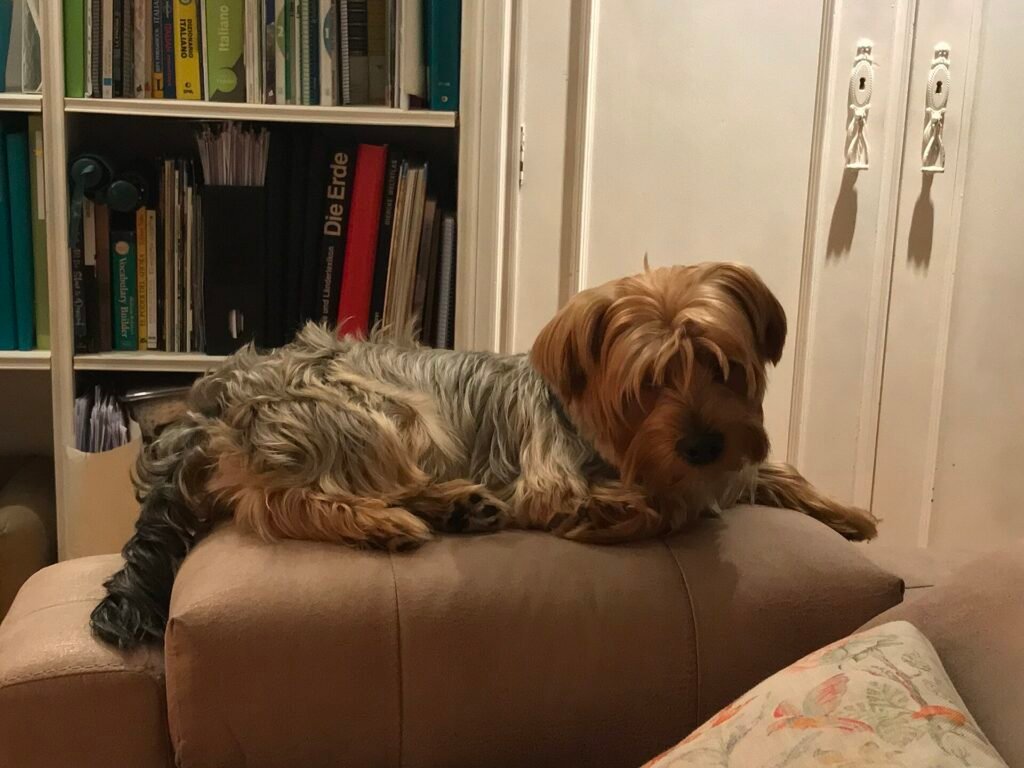
A quick note: a few links below are affiliate links. Buy through one and we may earn a small commission. It never costs you more, and we only point to gear we'd actually put in front of our own dogs. As an Amazon Associate I earn from qualifying purchases.
On paper the Yorkshire Terrier is the apartment dog. Seven pounds, barely sheds, needs a fraction of the exercise a big dog does, and fits comfortably in a studio. Every list puts it near the top and the reasoning is not wrong.
What the lists leave out is that the Yorkie is a terrier, and it was bred to work. The two things that go wrong in a flat both come straight from that, and neither has anything to do with size.
What You Should Know About Owning a Yorkshire Terrier
Yorkies stand around 7 to 8 inches at the shoulder and weigh 4 to 7 pounds. The breed standard caps them at 7. Anything advertised as a “teacup Yorkie” is not a separate variety, it is an undersized dog, usually from a breeder selecting for fragility, and the health problems that come with it are real and expensive.
The origin explains everything about the temperament. Yorkies came out of the textile mills and mines of nineteenth-century Yorkshire, where their job was killing rats. They were not lap dogs that got scaled down; they were working terriers that got scaled up in status. The result is a very small animal with a very large opinion of itself, no functioning sense of its own size, and the terrier habit of investigating anything that moves.
Lifespan is long, 13 to 16 years and often more. That is a genuine consideration: a Yorkie acquired today may still be with you in the flat after the next two moves.
Health matters to know about before you buy. Luxating patella, where the kneecap slips out of its groove, is common. So is collapsing trachea, which is why a Yorkie should walk on a harness and never a collar, without exception. Dental disease is close to universal in the breed because there are too many teeth in too small a mouth. Portosystemic shunt, a liver blood vessel defect, appears more often in Yorkies than in most breeds and a good breeder will have tested for it. Puppies are prone to hypoglycaemia and need frequent meals in the first months.
Are Yorkshire Terriers Good Family Dogs?
For adults and older children, yes. For households with toddlers, honestly, no.
This is not about the dog’s character. Yorkies are affectionate, funny, deeply attached to their people and often extremely good company. The problem is that a 5-pound dog and a small child occupying the same 600 square feet is a bad combination that ends one of two ways. Either the dog gets injured, because Yorkies are dropped, stepped on and sat on with depressing regularity, or the dog learns that a warning snap is the only thing that reliably makes a grabbing hand stop.
With children over about eight who have been taught how to behave around a small dog, the breed is fine and often becomes the child’s dog entirely.
Yorkies also tend to bond hard with one person in the household. Expect a shadow. In a flat that is mostly charming, though it feeds directly into the separation problem further down.
Do Yorkshire Terriers Bark a Lot?
Yes. This is the single biggest reason Yorkie owners get complaints, and it deserves more space than a one-line warning.
Terriers were bred to alert and to be persistent about it. A Yorkie announces the lift arriving, the neighbour’s door, the letterbox, footsteps in the corridor, another dog three floors down, and a sound outside that you cannot hear at all. The bark is high, sharp and carries through walls far better than a large dog’s low woof does, which is why the small quiet-looking dog generates more noise complaints than the Rottweiler down the hall.
It is trainable, but only if you treat it as a project from the first week rather than a phase to wait out. Alert barking that gets rehearsed daily for six months becomes a habit, and the habit is much harder to unpick than the original behaviour was to prevent.
What actually works: teaching a reliable interruption and rewarding the dog for coming to you instead of barking at the door, controlling what the dog can see and hear from the entrance, and never letting the dog learn that barking makes something interesting happen. What does not work: shouting, which the dog reads as you joining in, and anti-bark collars, which suppress the noise without touching the arousal underneath it. There is a longer breakdown in our guide to stopping a dog barking in an apartment, and if the neighbours are already involved, soundproofing against a barking dog covers the physical side.
Can a Yorkshire Terrier Be Left Alone?
Four to six hours for a well-prepared adult, and getting there takes deliberate work.
Yorkies are prone to separation anxiety, and the one-person attachment makes it worse. A dog that has never been left alone and then faces an eight-hour workday will usually escalate to sustained barking, which in a flat is not a private problem for long.
Build the alone time from the beginning: short absences while the dog is calm, gradually extended, with the leaving cues broken up so that picking up keys stops predicting departure. Do this before you need it, not after the first complaint.
Two practical notes. A Yorkie left alone all day will need an indoor toilet option, because the bladder is small and eight hours is not realistic; more on the options below. And the settle spot should be away from the front door, for the same reason it should be for every alert breed. If distress is already established, it does not resolve on its own, and our guide to calming an anxious dog covers the sequence worth working through.
Are Yorkshire Terriers Good Indoor Dogs?
Excellent, and this is where the breed genuinely earns its reputation.
The coat is a single silky coat that grows continuously rather than shedding out in cycles, so loose hair around the flat is minimal. There is very little doggy smell. The dog takes up almost no floor and no furniture. Exercise needs are small enough that a bad-weather day is not a crisis.
They are also genuinely happy indoors. A Yorkie that has had a walk and some attention will curl up somewhere warm and stay there, which is more than can be said for most terriers.
Two indoor caveats. Yorkies feel the cold badly, and a small dog with a single coat in an underheated flat in winter genuinely needs a jumper outdoors, not as decoration. And they are climbers and jumpers with no sense of their own fragility. Sofas and beds are a common source of injured knees; a set of pet steps costs very little and prevents a lot.
Yorkshire Terrier Exercise Needs
Thirty minutes a day, split into two walks, covers the physical requirement for most adults. Some individuals want considerably more and will happily take an hour.
The mistake owners make is treating that low number as the whole picture. This is a terrier: the body is small but the drive is not. A Yorkie that gets its two short walks and nothing else is under-stimulated, and an under-stimulated terrier finds work. Usually that work is barking, digging at the sofa, or shredding something.
Give the brain something to do daily. Scent games with treats hidden around the flat, puzzle feeders, short training sessions, a flirt pole in a hallway. Ten minutes of that does more for a Yorkie’s evening behaviour than another lap of the block, and it takes up no space.
Always a harness, never a collar. The trachea in this breed is genuinely fragile and lead pressure on the throat causes real damage over time.
Yorkshire Terrier Grooming Needs
This is the trade-off for the low shedding, and people underestimate it.
Yorkie coat is closer to human hair than to typical dog coat. It keeps growing, and left alone it mats, particularly behind the ears, under the legs and around the collar. A full-length show coat needs daily brushing and is genuinely a lot of work.
Most owners, sensibly, keep their dog in a short puppy clip. That means a professional groom every four to eight weeks and brushing a few times a week in between. It is a standing cost for the life of the dog, and it is worth pricing before you commit rather than discovering it in month three.
The rest: nails regularly, since a small dog on carpet does not wear them down; ears checked and the hair kept clear; and teeth, which is the important one. Dental disease in Yorkies is close to inevitable without daily brushing, and dental extractions under anaesthetic in an elderly small dog are expensive and unpleasant. Start brushing in puppyhood while the dog will tolerate it.
Face and eyes need a wipe most days; the hair grows into the eyes and tear staining is common.
Are Yorkshire Terriers Easy to Train?
Smart, capable, and not especially biddable. Which is to say: yes, but you have to mean it.
Yorkies learn quickly. They also have the terrier trait of deciding whether the request is worth their time, and small dogs are chronically under-trained because owners let things slide that they never would with a big dog. Nobody lets a Rottweiler jump up. Everybody lets a Yorkie.
The result is the classic small-dog behaviour package (barking at guests, guarding the sofa, refusing to be picked up), which is not a size trait at all. It is a training gap. Treat a Yorkie like a real dog with real rules and you get a well-behaved real dog.
Housetraining is the hard part, and it is worth being blunt about it. Yorkies are among the more difficult breeds to house-train reliably. The bladder is tiny, the accidents are small enough to miss, which means they get missed and the spot gets reused, and a dog that weighs five pounds is entirely reasonable in refusing to go out in the rain. Add four flights of stairs or a slow lift and the timings stop working.
The realistic apartment answer is a consistent routine plus an indoor option, at least in the early months and in winter. Our guides to apartment puppy potty training and indoor dog potty options cover how to do that without ending up with a dog that has decided the whole flat is available.
Is a Yorkshire Terrier a Good Apartment Dog?
Yes, clearly, and for the right household it is one of the best choices on this site.
The fundamentals are all in its favour. It is small enough for any flat, it barely sheds, it does not need a garden, thirty minutes of exercise is achievable on a working day, it fits in most pet-restricted leases without argument, and it lives a long time. There is no size or space objection to make.
Where it fails is narrow and predictable. It fails when nobody addressed the barking in the first three months and the building manager is now writing letters. It fails when the housetraining was never finished and the flat smells. And it fails when the owner did not price the groomer every six weeks for the next fourteen years.
All three are solvable, and all three are far easier to prevent than to fix. Notice that none of them is about square footage. The Yorkie is not a compromise you make because your flat is small. It is a good dog with two demanding habits, and if you go in knowing which two, it works.
The household it does not suit: one with a toddler, and one where nobody is home for nine hours a day and there is a shared wall.
Tips for Raising a Yorkshire Terrier in an Apartment
1. Start on the barking in week one, not month six
Reward the dog for coming to you when it hears something rather than for announcing it. Block the view of the front door. Keep a low steady background noise running so that corridor sounds do not arrive out of silence. A Yorkie that never learns the door-barking routine is a completely different animal to one you are trying to un-teach at a year old.
2. Set up an indoor toilet from the start, and put it somewhere permanent
Not as an admission of defeat, as apartment logistics. A five-pound bladder, four flights of stairs and a February downpour do not combine well. Pick a spot, keep it there, and reward heavily for using it. Moving it around later is what teaches a dog that the whole flat qualifies.
3. Harness only, and steps up to the furniture
Two small purchases that prevent the two most common Yorkie injuries. The trachea does not tolerate lead pressure, and the knees do not tolerate a daily jump down from a sofa that is eight times the dog’s height.
4. Book the groomer on a standing schedule and brush the teeth daily
Every four to eight weeks for the coat, and two minutes a day for the teeth. Both are boring, both get skipped, and both turn into expensive problems in a breed that lives fifteen years. Condition the puppy to being handled early and neither is a fight.
5. Treat it like a dog, not an accessory
Let it walk. Make it wait at the door. Do not pick it up every time another dog approaches, which teaches it that other dogs are a threat and creates exactly the snappy little dog people expect. The Yorkies with behaviour problems are almost always the ones who were never asked to do anything.
Final Thoughts
The Yorkshire Terrier deserves its place on the apartment lists, but for the wrong reason. It is not a good flat dog because it is small. It is a good flat dog because it sheds almost nothing, settles indoors, needs half an hour of exercise, and lives happily in a space that would make a Husky miserable.
The two things that will decide how it goes for you are the barking and the housetraining, and both are decided in the first three months. Get those right and you have fourteen years of an easy, funny, ridiculously self-important little dog in a small space. Get them wrong and you have a noise complaint and a stained carpet, and the flat had nothing to do with either.
Related Content
- The dog-friendly apartment checklist
- How to stop a dog barking in an apartment
- Indoor dog potty options for apartments
- Apartment puppy potty training
- How to calm down a dog with anxiety
Frequently asked questions
Can big dogs really live in an apartment?
Yes. Energy level matters far more than size. A calm Great Dane settles into a flat better than a wound-up terrier, as long as it gets a proper walk twice a day.
Which dog breeds bark the least in apartments?
Greyhounds, Basenjis, Bulldogs and Cavaliers are among the quietest. Any dog can learn to be calm, but these simply start at a lower volume.
How much exercise does an apartment dog need?
Most do well on 30 to 60 minutes a day split into two walks, plus a little indoor play. Cut that short and the barking and chewing usually start.
Google lets you pick which sites come up first in your own results.